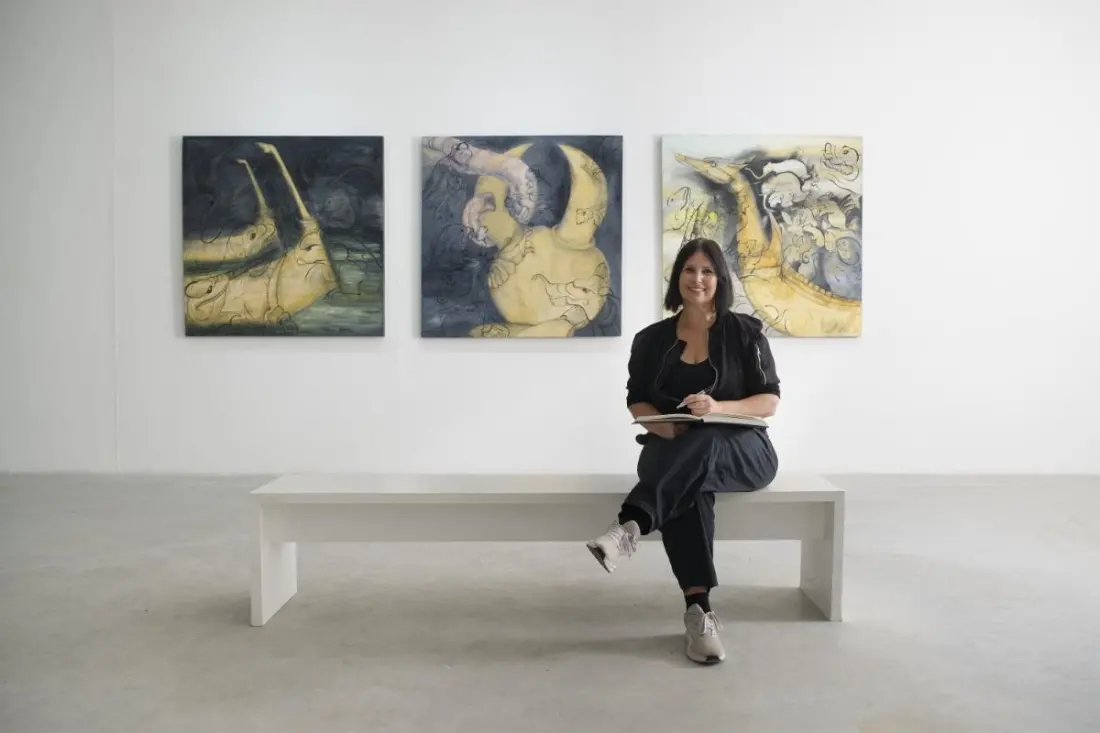
British artist Miranda Housden has spent two decades in Cornwall, living beside the Tamar Estuary where the shoreline drains twice a day. So when she relocated to Bangkok for a two-month residency, she arrived in a city whose relationship with water is entirely different — roads turn into rivers during floods, pavements become canals, and monsoon rain rewires daily life. That collision of water cultures is the engine behind "Confluent", her solo exhibition at Bangkok University Gallery, on until November 25.
The show pulls together painting, sculpture and film, much of it made during her time in Thailand. Her earlier work drew on ideas of passage and transformation that recur in Western myth — a golden sun, a golden bar resting on an elephant's trunk, close-ups of a dancer's hands exploring a sculpted piece shaped like swirling water. The film "Snowfall" projects those same images, tying the two traditions together on screen.
For the Bangkok chapter, Housden went digging into Thai mythology, the Himmapan Forest — the mythical realm of creatures said to separate heaven and Earth — and Buddhist ecology. She found that the same themes of passage and transformation were already present in her own work, just wearing different clothes. In her words, the show became a conversation between visual culture, Thai myth and the contemporary environment, all circling questions of exchange, transformation and how humans relate to natural systems.
The gallery's director, Chayanon Slisatkorn, frames it neatly: the exhibition shows how artistic practice can open a dialogue between different cultural traditions without erasing what makes each distinct.
Housden's CV explains why the two hemispheres sit so comfortably side by side here. She trained as a sculptor at Falmouth School of Art and the Chelsea School of Art in the late 1980s, worked in Rome, Prague and London, then moved to Cornwall in 2015. Her large-scale installations, drawings, paintings and films have been shown widely across Europe and Asia, including at the Bangkok Art and Culture Centre and Thailand's Biennale in Krabi — so Thai audiences may already know her work.
For travellers in Bangkok this season, it's a solid excuse to step off the usual temple-and-market circuit. Bangkok University Gallery is one of the city's more interesting contemporary art venues, and shows like this — where a European artist genuinely engages with local myth rather than skimming the surface — don't come around every month. Pair a visit with BACC's current programme or a weekend trip south, and you'll get two very different readings of how this country thinks about water.
Story via Bangkok Post Life.