On Erub (Darnley) Island, roughly 200km north-east of Cape York in the Torres Strait, a group of Indigenous artists is turning one of the ocean's nastiest problems into sculpture that now hangs in museums around the world.
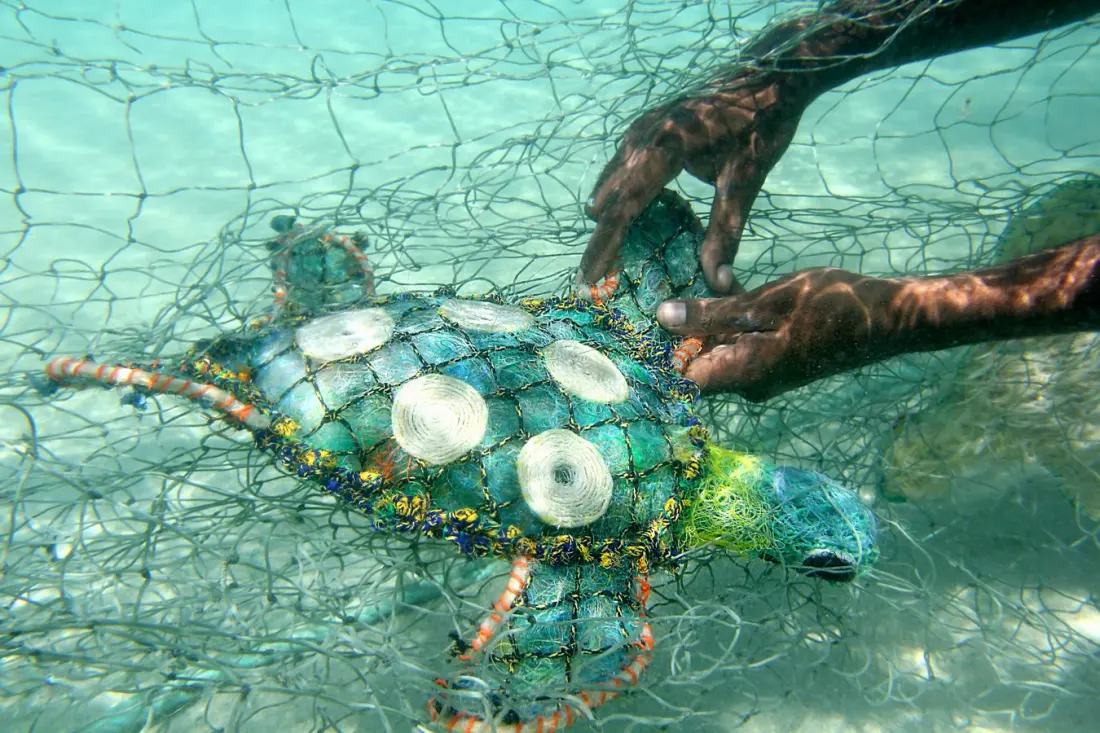
Their raw material is ghost nets: abandoned fishing nets and ropes that drift in from Southeast Asian waters or slip loose from trawlers. These invisible walls roll along the seabed, entangling turtles, dugongs, dolphins, sharks and coral across the Great Barrier Reef and the island shores. Rather than despair, local rangers haul the debris onto barges and deliver it to the Erub Arts centre, where artists like Nancy Naawi, Florence Gutchen and Lavinia Ketchell wash, untangle, sort and re-stitch it into turtles, rays, fish and jellyfish using traditional weaving and crochet techniques.
The project began in 2010 with backing from GhostNets Australia and Arts Queensland, pairing First Nations artists with non-Indigenous collaborators including co-founders Diann Lui and Lynnette Griffiths. It scaled up fast. At the 2011 Cairns Indigenous Art Fair, their 2.5-metre squid Illum caused a sensation, and the Australian Museum soon commissioned Dauma and Garom, a 6-metre piece retelling an island love story between a rock cod and rock crab. Since then, their work has reached the British Museum, the Oceanographic Museum in Monaco, Geneva's Musée d'ethnographie and Singapore's Asian Civilisations Museum, and one turtle sculpture even made it onto an Australian stamp.
A standout project is Mermer Waiskeder: Stories of the Moving Tide, eleven illuminated giant rays suspended in Sydney's Exchange Square at Barangaroo, each with hundreds of tiny sewn stingrays tucked underneath. Eight months of stitching went into them — and yes, they're named Raynaldo, Raymond, Raynbow, Raylene and Raychel.
The deeper story is environmental. The artists bleach-white patches into their reef tableaux to mark coral bleaching, and they speak plainly about marine heatwaves, stranded sardines and nesting grounds lost to rising seas. Works are deliberately beautiful, but the message — think before you abandon a net — travels with them. As centre manager Gladys Doolah puts it, people love that the artists made something beautiful out of a growing problem.
For travellers, this is a reason to look beyond the usual reef itinerary. Erub Island is one of Australia's most remote communities, but the artists' work appears at the Cairns and Darwin Indigenous art fairs, and Sydney's Barangaroo installation is free to visit any day. Buying or even just seeing ghost-net art supports a genuinely local conservation effort and a craft practice where up to nine artists might share a single piece.