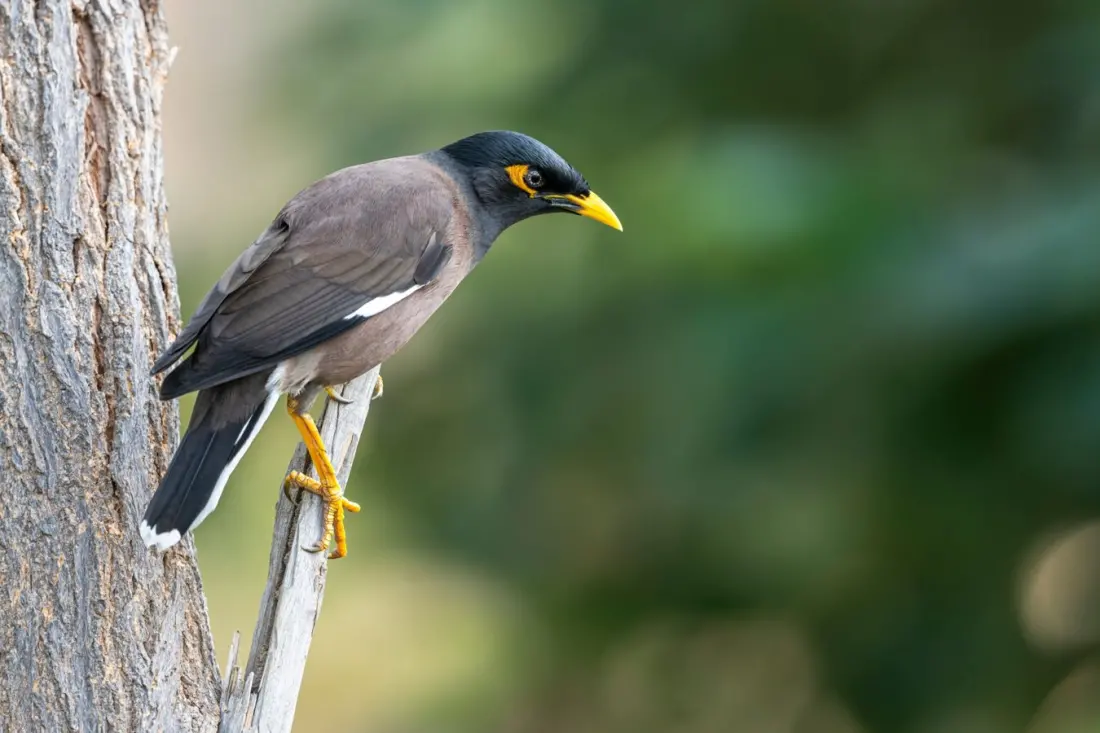
The common myna — that bold, brown-and-yellow starling strutting through car parks from Cairns to Canberra — hasn't always been public enemy number one. An environmental historian at the University of Melbourne, Simon Farley, has traced how the bird's reputation flipped completely over its 164 years in Australia, and the story says as much about people as it does about birds.
Mynas arrived in Victoria in 1862, and in North Queensland around Ingham and Townsville in 1883, deliberately brought in to eat locusts and other insects — a well-meaning move that echoes the later cane toad fiasco. For decades the bird was a hit. An 1886 Sydney newspaper writer called mynas 'highly amusing'; naturalist Charles Barrett praised Melbourne's birds as graceful in 1906; and as recently as 1971, revered birdwatcher Alec Chisholm defended the 'entertainer' from India as harmless and very much at home.
The turnaround came in the 1970s, hardening through the 1980s and 1990s alongside a broader backlash against 'invasive' species. Newspaper language turned ugly — 'invaders', 'foreign bullies' — and some commentary veered into xenophobic metaphor. Only in the late 1990s did serious research emerge on the bird's actual impact, and it's real but nuanced: mynas can outcompete native parrots for scarce nesting hollows, earning them the label 'flying cane toads'. In 2000 the IUCN listed them among the world's 100 worst invasive species.
Fast forward to 2026, and Queensland communities are again distributing traps and offering bounties, following similar grassroots campaigns in Canberra from 2012. Farley is sceptical about the cycle: trapping may simply make mynas warier and live in smaller, hidden groups, creating the illusion of decline before numbers rebound. There's also an ecological catch — removing mynas can leave a vacuum filled by the noisy miner, a native honeyeater that's equally aggressive towards vulnerable species.
For travellers, this is a genuinely useful piece of context. Birdwatchers visiting eastern Australia will encounter mynas constantly, and knowing they're a cultural lightning rod — not just a garden nuisance — adds depth to a day's birding around Brisbane, Townsville or the Victorian goldfields towns. The bigger takeaway for anyone with an interest in conservation: eradicating introduced species is rarely simple, sometimes impossible, and the energy spent on an unwinnable war might be better spent protecting habitat. Farley's suggestion isn't to love the myna, but to accept that a new equilibrium — native and introduced species sharing altered cities and towns — may be the realistic outcome.
So next time a myna eyes off your chips at a seaside café, spare a thought for a bird that was once a welcome immigrant, then a symbol of everything wrong with the environment, and is now simply a permanent — if contentious — fixture of Australian streets.
Original reporting by Australian Geographic.