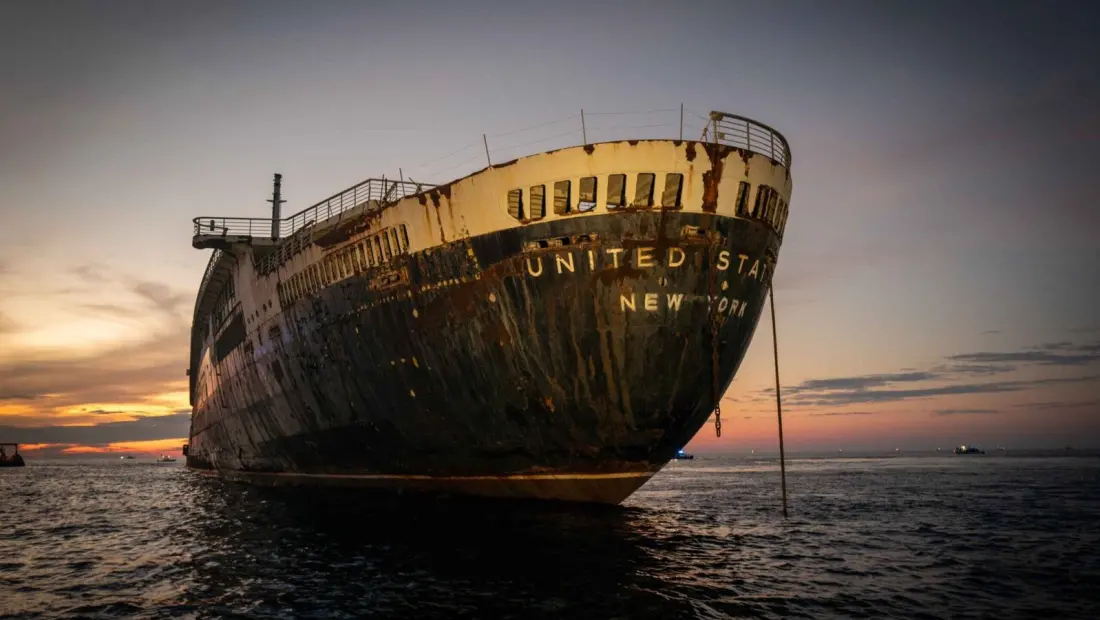
The fastest ocean liner ever built has made her slowest exit. On the evening of November 11, the 990-foot SS United States slipped beneath the Gulf of Mexico roughly 22 nautical miles southwest of Destin, Florida, taking nearly four hours to go under after the valves opened. The controlled scuttling makes the legendary liner the world's largest artificial reef, overtaking the USS Oriskany, which held the title since 2006.
It's a striking second act for a ship that once crossed the Atlantic faster than the Queen Mary — by about ten hours on her 1952 maiden voyage. Pulled from service in 1969, she spent nearly thirty years docked in Philadelphia while successive rescue plans failed: Crystal Cruises studied a return to service in 2016 and gave up, and a rent dispute finally forced the historic vessel off her pier in 2024. With restoration off the table, the conservancy sold her to Okaloosa County for $1 million, and the county has spent upwards of $13 million on remediation, towing and preparation.
The motivation is part marine habitat, part tourism play. The seafloor off Destin and Fort Walton Beach is mostly sand with little natural reef, and the county's five-year, $12 million plan aims to turn the area into Florida's diving capital, funded partly by tourist-development taxes. The ship is expected to join the Florida Panhandle Shipwreck Trail, a passport-style route of more than 20 sunken vessels created after the Deepwater Horizon spill. Crews drained the fuel tanks and removed what the county says is 99 percent of PCB-containing materials, though a dispute over the ship's old zinc-chromate primer prompted a last-minute federal lawsuit that a judge rejected days before the sinking.
For divers, the practical picture is appealing. She rests in about 180 feet of water, but early sonar suggests the upper decks sit at roughly 50 to 60 feet, within reach of Open Water-certified divers. Going deeper requires Advanced Open Water, with wreck and Nitrox certifications recommended; the lower decks are strictly for technical divers. Access dates are still being finalised while safety divers clear the site, but local operators like Niuhi Dive Charters and ScubaTech Destin are hoping to run trips almost immediately, and bookings are already coming in from around the world. Expect a full-day offshore excursion from Destin. Meanwhile, the ship's funnels, propeller and radar mast will go to a planned land-based museum near Destin, and Woods Hole will monitor the new ecosystem at more than 130 tagged points over the next decade.
Why care? Even if you never strap on a tank, this is one of the strangest and most compelling travel stories of the year: a national maritime icon reborn as an underwater destination, and a county betting millions that divers will cross oceans to see her. Snorkellers and history buffs can get their fix topside at the future museum, while certified divers get bragging rights few will ever match.