It's the most theatrical reptile in Australia, but the frill-necked lizard spends almost none of its life doing the thing it's famous for. Despite countless postcards showing it with its enormous neck flap flared wide, this lizard keeps that dramatic display in reserve — and mostly lives quietly in the trees.
Found across the tropical woodlands and savannas of northern Australia and southern New Guinea, the frill-necked lizard (Chlamydosaurus kingii) — also called the frilled dragon or frilled agama — spends roughly 90 per cent of its time up trunks and branches, camouflaged against bark. It only descends when dinner walks by: a caterpillar, ant or beetle on the forest floor gets snatched, and the lizard sprints straight back up its tree. For a frill-neck, the ground is dangerous territory where predators can appear at any moment.
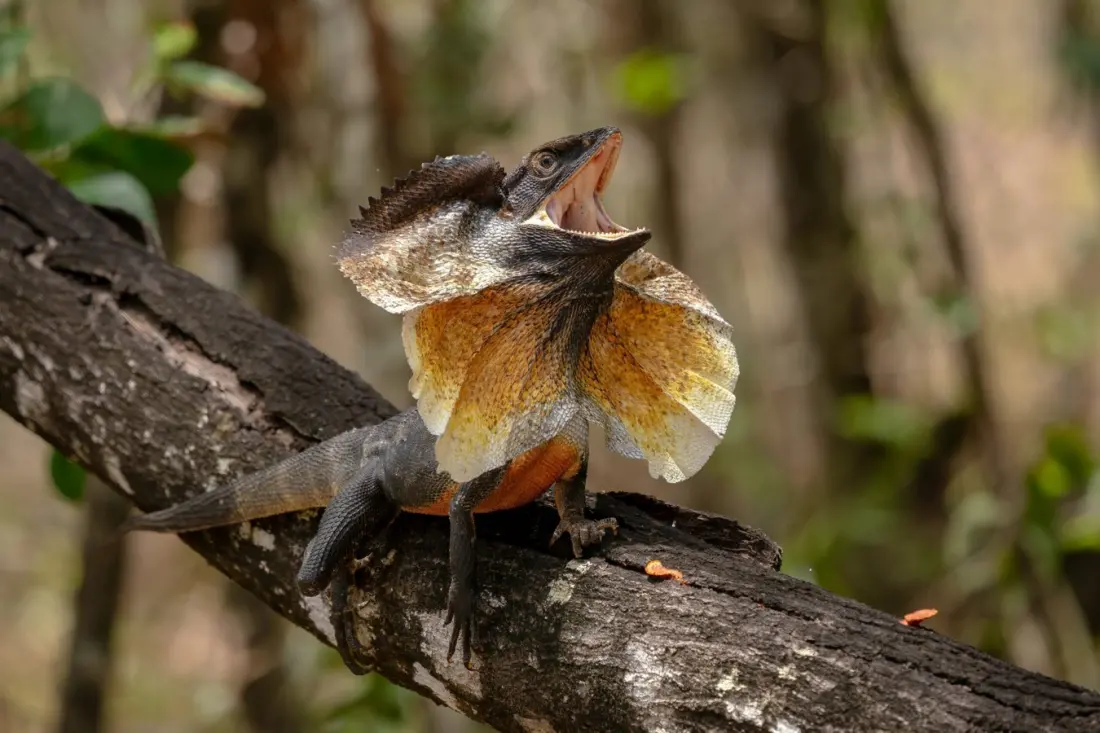
If cornered away from a tree, the famous frill finally comes out. The lizard gapes its mouth wide — a crucial detail, since structures in its throat brace the frill and opening the jaws helps push the flap outward — and unfurls the skin around its neck in what it hopes is a terrifying bluff. The colours make it even more striking: frills run from white and yellow to blazing orange and red, with western Australian populations tending red and eastern ones leaning yellow or white.
Those colours do more than scare things off. Research from Macquarie University and ANU found that males with brighter red-orange frills win more contests against rivals of similar size — the frill doubles as a signal of quality.
And when bluffing fails? The lizard rears onto its hind legs and sprints away on two feet, tail out for balance. It looks absurd, but the technique works: bipedal running isn't more energy-efficient than four-legged running, but it lets a lizard accelerate fast — handy for a rapid getaway. Strangely, frill-necks also use this upright style when casually foraging, not just when fleeing.
Why should travellers care? Because northern Australia is one of the few places on earth where you might see this living cartoon in the wild. If you're visiting the Top End — Darwin, Kakadu or Litchfield National Park — keep an eye on tree trunks in woodland and savanna habitats rather than scanning only the ground. Spotting one mid-climb, bark-coloured and still, is a genuine bucket-list wildlife moment, and if you're extraordinarily lucky (or unlucky), you might witness the frill or the two-legged sprint in person. It's a reminder that Australia's wildlife shows don't need a guide with a spotlight: sometimes the best theatre is hiding on a tree branch, waiting for a caterpillar.