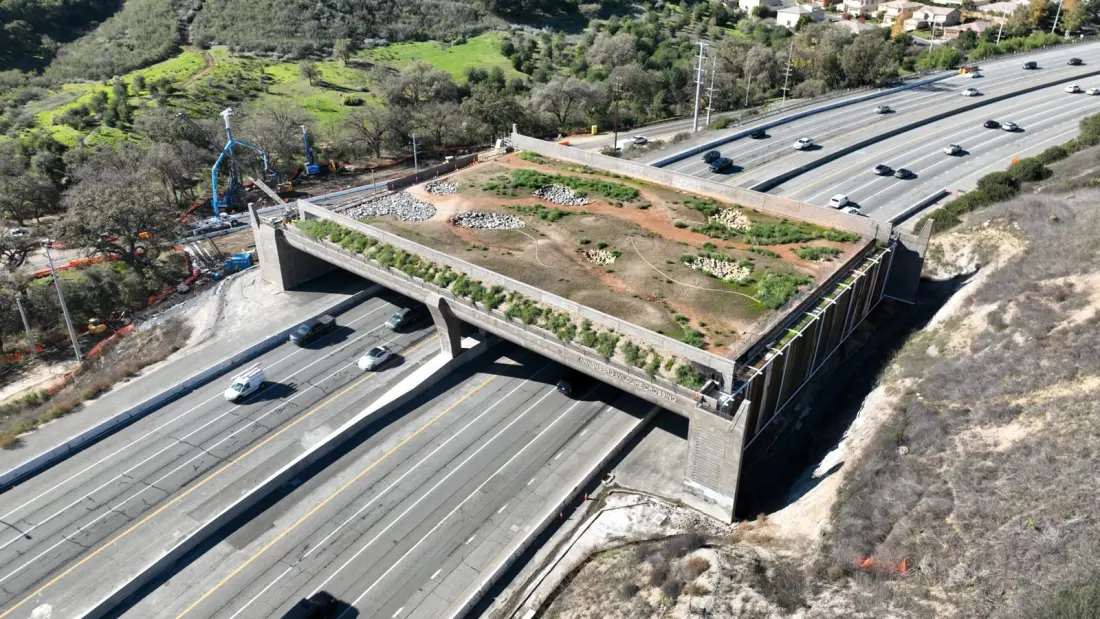
A bridge built not for cars but for cougars is nearly ready. On 2 December 2026, the Wallis Annenberg Wildlife Crossing opens in Agoura Hills, northwest of Los Angeles, carrying mountain lions, bobcats, deer and coyotes over all ten lanes of US Route 101. It is the largest structure of its kind anywhere, and it lands in one of the least likely places: the edge of a sprawling American metropolis.
The crossing spans Liberty Canyon, a spot where the freeway slices straight through habitat that animals once roamed across freely. For mountain lions in the Santa Monica Mountains, that road has become a genetic wall — hemmed in by urban sprawl, the big cats have struggled to find mates on the other side, and inbreeding has become a real conservation worry. The bridge reconnects the mountains with the Simi Hills, and it should also cut down on wildlife-vehicle collisions along a corridor used by hundreds of thousands of drivers daily.
The engineering is quietly impressive. The main span runs 210 feet (64 metres) over the freeway, with a second bridge next door taking animals over Agoura Road, so a deer or bobcat can clear both roads in one continuous passage. Together the two structures cover nearly 56,000 square feet — roughly 5,200 square metres — planted with oaks and other native vegetation so it reads as ordinary habitat rather than concrete. Fencing will funnel animals toward the route, while barriers block out headlights and traffic noise.
It hasn't been a smooth build. Work began on Earth Day in 2022 with a 2025 target and a $92 million price tag; heavy rain and flooding pushed the finish line back, and the bill has climbed to about $114 million. The Agoura Road section alone required crews to move power and telecom lines, reroute a regional water main, and sink concrete supports roughly 75 feet deep — all while tiptoeing around two creeks and dozens of mature oak trees.
The science is the fun part. Coyotes and bobcats were already poking around the site during construction. Once the bridge opens, more than 50 cameras will monitor who uses it, and researchers will compare movement patterns against a two-year study that tracked five species before the crossing existed. Some deer will even be fitted with heart-rate monitors, so scientists can tell whether an animal strolling over ten lanes of LA traffic is secretly stressed. The ultimate benchmark, according to David Szymanski, superintendent of the Santa Monica Mountains National Recreation Area, is whether animals cut off by the freeway start breeding across it again.
For travellers, this is a reason to look beyond the beaches on a Los Angeles trip. The crossing sits at the gateway to the Santa Monica Mountains National Recreation Area — 150,000-plus acres of hiking trails, canyon roads and wildlife within sight of the city. Once it opens in December 2026, it will be visible from the 101, and the surrounding parkland makes a genuinely wild day trip from central LA. It's also a story worth following: whether the world's largest wildlife bridge actually rewrites the genetic fate of the region's famous mountain lions will be one of conservation's most watched experiments.
Reporting by Travel Tomorrow.