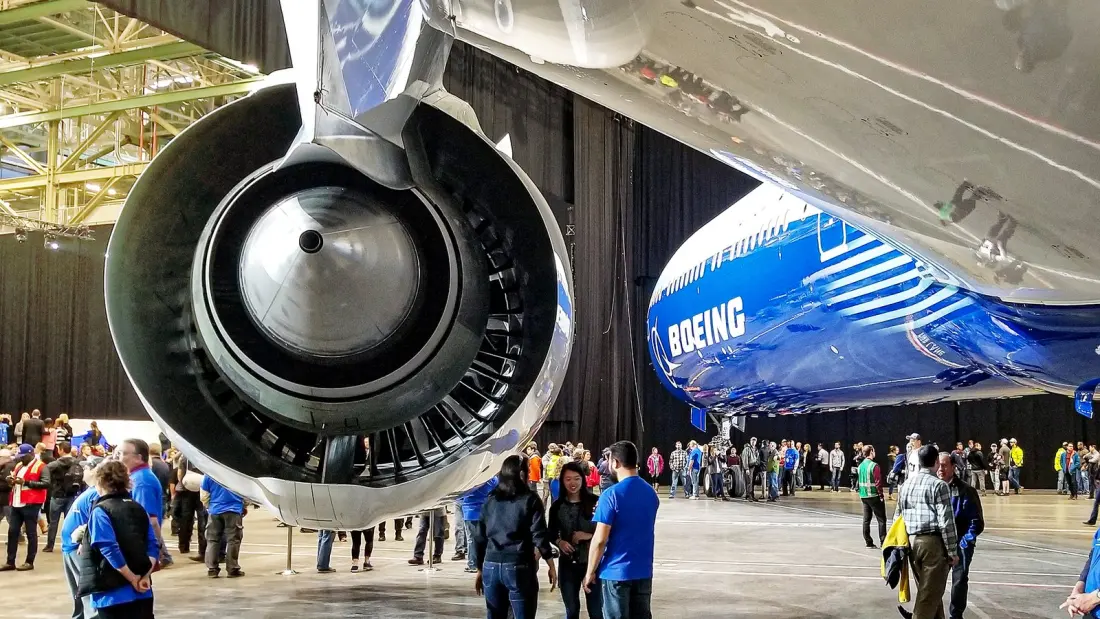
The engine destined to power Boeing's next flagship widebody, the 777X, carries a catalogue price of roughly $40-45 million each — about $90 million per aircraft on paper. That makes General Electric's GE9X the priciest commercial engine ever built, and it's also the single component holding up certification of a jet that 682 firm orders are waiting on.
How did it get so expensive? Partly by design. GE holds a sole-source monopoly on the 777X, a position it secured years ago when Rolls-Royce and Pratt & Whitney were frozen out of bidding. Launch deals looked staggering: Emirates signed for 300 engines valued at over $11 billion, and Singapore Airlines' 2022 order for 22 spares with a 12-year maintenance contract topped $100 million per engine on paper. In reality, airlines pay far less after volume discounts, because GE's real money comes from decades of sole-source overhaul revenue.
The engineering justifies some of the cost. In a 2017 ground test in Ohio, the engine hit 134,300 pounds of thrust — a Guinness World Record — though production versions are deliberately dialed back below that to burn 10% less fuel. Its core uses ceramic matrix composites that survive temperatures up to 2,400°F, plus more than 300 3D-printed parts, including fuel nozzles that are 25% lighter than conventional ones.
But the programme has been a financial slog. Compressor vane wear forced a redesign in 2019; a broken titanium thrust link grounded all four 777-9 prototypes for five months in 2022; and in January 2026 inspectors found a prematurely wearing mid-turbine seal. That seal is now the last hurdle before final certification, with GE shipping repaired engines and targeting commercial service in 2027. Boeing has absorbed around $15 billion in pre-tax charges, and customers are fuming — Emirates president Tim Clark rejected his first ten parked jets as "baked bean cans," while Lufthansa has kept old Airbus A340s flying longer as a result.
Why should a traveller care? Because the 777X will reshape long-haul flying once it arrives. Boeing has widened the cabin to 235 inches, fitted 18-inch economy seats, larger windows, higher humidity and cabin pressurisation equivalent to just 6,000 feet — so you should land from a 14-hour flight feeling noticeably less wrecked. It's also quieter: test pilots reportedly checked the gauges to confirm the engine was running. For anyone booking with Emirates, Qatar Airways, Singapore Airlines or Lufthansa later this decade, this engine is the reason your new aircraft is late — and the reason it should be a better ride when it shows up.
There's a twist to watch, too: if Airbus green-lights a stretched 400-seat A350-2000 around 2030, GE might break its truce with Rolls-Royce and fit a GE9X derivative under an Airbus wing.