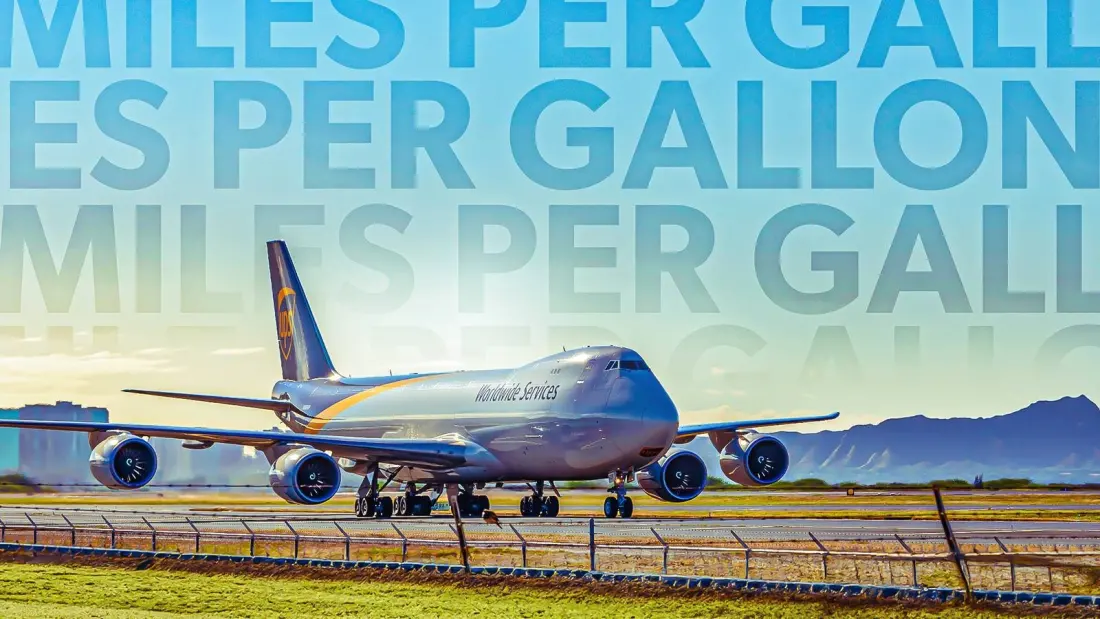
A cruising Boeing 747 burns roughly 3,500 to 3,800 gallons of jet fuel every hour — about four litres per second. At its typical cruise speed of 580 mph, that works out to a mere 0.18 miles per gallon, with each mile covered costing around 5.9 gallons. Taken at face value, that sounds appalling next to the 50 mpg considered decent for a car.
But the raw figure is misleading. A 747 isn't carrying one person; Qantas configured its 747-400s with 364 seats across three classes. Spread the fuel burn across those passengers and you get roughly 65.5 mpg per traveller in cruise — better than a car with a solo driver, though a car carrying two or more people still wins on fuel per person. Takeoff complicates the comparison further: getting a plane weighing close to a million pounds airborne is the most fuel-hungry phase of any flight, requiring around 5,000 gallons.
To sustain that appetite, the 747 carries enormous quantities of fuel — up to 63,034 gallons on the 747-8, mostly stored in the wings to free fuselage space for cargo. A single London-to-New York flight burns roughly 70,000 kg of fuel. The fuel system has even drawn regulatory attention: in 2022 the FAA investigated improperly applied cap seals on 747-400F freighters, which could theoretically allow arcing inside fuel tanks during a lightning strike.
What about newer planes? Modern two-engine widebodies like the Airbus A350 and Boeing 787 burn far less fuel per hour — about 2,700 and 2,900 gallons respectively — but they also carry fewer people. Per passenger, the maths is surprisingly close: the A350 works out near 50 mpg per seat and Qantas's 787-9 around 45, roughly equivalent to a single-occupant car rather than a clear improvement over the old Queen of the Skies.
There's also the altitude problem. Jet fuel and petrol emit similar CO2 per gallon, but burning fuel at cruise altitude has extra effects — contrails containing black carbon, nitrous oxides and sulphur compounds. One cited study found aviation's climate impact per passenger-hour is 6 to 47 times higher than car travel over short time horizons.
The industry's big hope is sustainable aviation fuel, which works in today's engines without modification. Studies suggest it could cut aviation's greenhouse gas emissions by 80% or more — Virgin Atlantic flew the first 100% SAF transatlantic flight on a 787 in 2023. The catch is cost: around $6 per gallon versus $2.29 for conventional jet fuel, with production nowhere near the estimated 3 billion gallons a year needed.
For travellers, the takeaway is that flying long-haul isn't dramatically worse per person than driving alone — but shared car journeys and trains still beat both, and greener flying depends more on SAF scaling up than on the plane you happen to board.