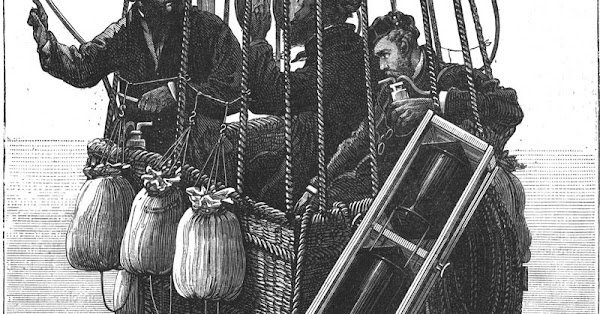
On 15 April 1875, three French aeronauts lifted off from the La Villette gasworks in Paris aboard a 3,000-cubic-metre balloon called the Zenith. Their goal was scientific: to study the upper atmosphere, carrying an aneroid barometer, a hygrometer, an electroscope and small reservoirs of oxygen-rich gas with rubber mouthpieces for breathing at altitude. Only one of them came back alive.
The crew was an experienced one. Gaston Tissandier was a scientist and writer fascinated by meteorology; Joseph Croce-Spinelli was a journalist who had already taken part in high-altitude experiments; Theodore Sivel, a former sailor, had designed the balloon itself. Just weeks earlier, most of the same team had completed a record 24-hour-and-40-minute endurance flight, and the glowing press coverage encouraged the Societe Francaise de Navigation Aerienne to push for an altitude record.
By around 1 p.m. the Zenith had passed 5,000 metres, with the temperature at a bone-chilling minus 10 Celsius. At 7,000 metres, Tissandier noticed his companions turning pale. Sivel, already dulled by the thin air, asked whether they should climb even higher — and Tissandier, himself lethargic, agreed. Sivel cut three bags of ballast and the balloon shot upward. By 7,500 metres Tissandier could barely move; he later wrote that he felt no pain, only a strange inner joy and indifference. At roughly 8,000 metres he tried to shout a barometer reading, found the words would not come, and collapsed.
What followed was a nightmare of blackouts and desperate, half-conscious decisions. Tissandier woke at 2:08 p.m. to find the balloon plummeting, cut a single bag of ballast, and passed out again. He came round briefly to see Croce-Spinelli throwing out the respirator, blankets and more ballast — sending the balloon higher, exactly the wrong move. Hypoxia had quietly stripped the crew of the judgment they needed to save themselves. When Tissandier finally shook his companions awake, neither responded. The Zenith slammed down near the village of Ciron, about 250 km from Paris, at 4 p.m. Tissandier survived, badly weakened; Sivel and Croce-Spinelli were dead. They are buried under a shared monument in Paris's Pere Lachaise Cemetery.
The tragedy taught aviation a grim lesson: carrying oxygen is useless if hypoxia has already stolen the ability to use it. Reduced pressure at altitude starves the blood of oxygen, and one of the condition's cruellest features is that victims lose the insight to recognise their own danger. Tissandier's fragmentary, honest account of the flight became essential reading for later aeronauts.
For travellers with an interest in aviation history, the story is anchored in very visitable places: the launch site in Paris's former industrial La Villette district, now a park and science quarter, and Pere Lachaise, where the two men's tomb remains one of the cemetery's more poignant stops.