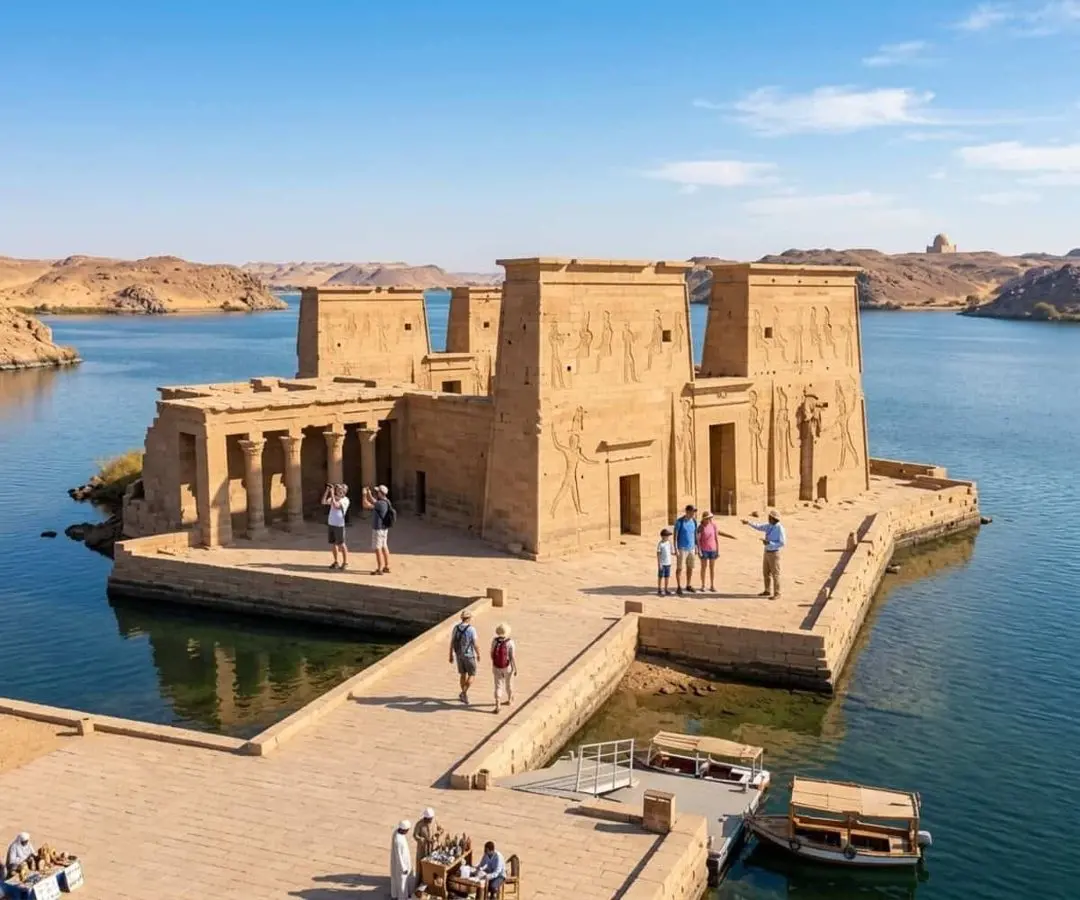
Most Nile cruises treat Aswan as the closing scene: two nights, a trip to Philae, then off to Abu Simbel or the airport. But travellers who linger find a different city — slower, greener-edged, and far more Nubian than Luxor ever feels. The river runs wide here, sand nearly touches the water, and feluccas drift between islands with no obvious urgency. Adding a single extra day can transform how the whole trip sits in memory.
Start on the water itself. A felucca ride is as simple as sailing gets — wind, sail, movement — and the classic routes circle the Botanical Garden on Kitchener's Island or head across to the Aga Khan Mausoleum on the West Bank, which is far better approached by river than by road.
For views, climb to Qubbet el-Hawa, a hillside cemetery of Old and Middle Kingdom tombs belonging to governors and officials. Some are decorated with military and trading scenes, and the tomb of Sarenput II retains coloured reliefs. The real payoff, though, is turning around: the Nile curls below, Elephantine Island sits midstream, and you suddenly understand why this was Egypt's southern gateway for centuries.
Elephantine itself deserves more than the usual hour. Ruins mark where ancient Egypt's border and Nubia trade met, but the island's living Nubian villages — brightly painted houses, kids playing football, small places to eat — are the highlight. It's a neighbourhood, not an attraction, so visit as a respectful guest.
Before wandering those villages, spend a couple of hours at the Nubian Museum. Opened in 1997 as an offshoot of the international campaign to save monuments flooded by the High Dam, it holds thousands of objects telling Nubia's long story in a building of local sandstone and pink granite. Seeing it first gives the villages and their crafts much more context.
If time allows, add Kalabsha — a Roman-era temple to the Nubian god Mandulis, dismantled and reassembled at New Kalabsha during the dam rescue — and the medieval St. Simeon Monastery, a desert walk that proves Aswan's history isn't only pharaonic. At the Unfinished Obelisk, take a guide: the quarry's trenches, tool marks and ancient implements only come alive with explanation.
And then, do nothing. A late-afternoon felucca with no commentary, watching the light soften over the desert, is the kind of experience that suits Aswan best. It's a place where the day can be built around the traveller rather than a checklist — pharaonic, Christian, Islamic and Nubian layers all within a short walk or boat ride. You don't need another sight; you need another day.
Story via A Luxury Travel Blog.