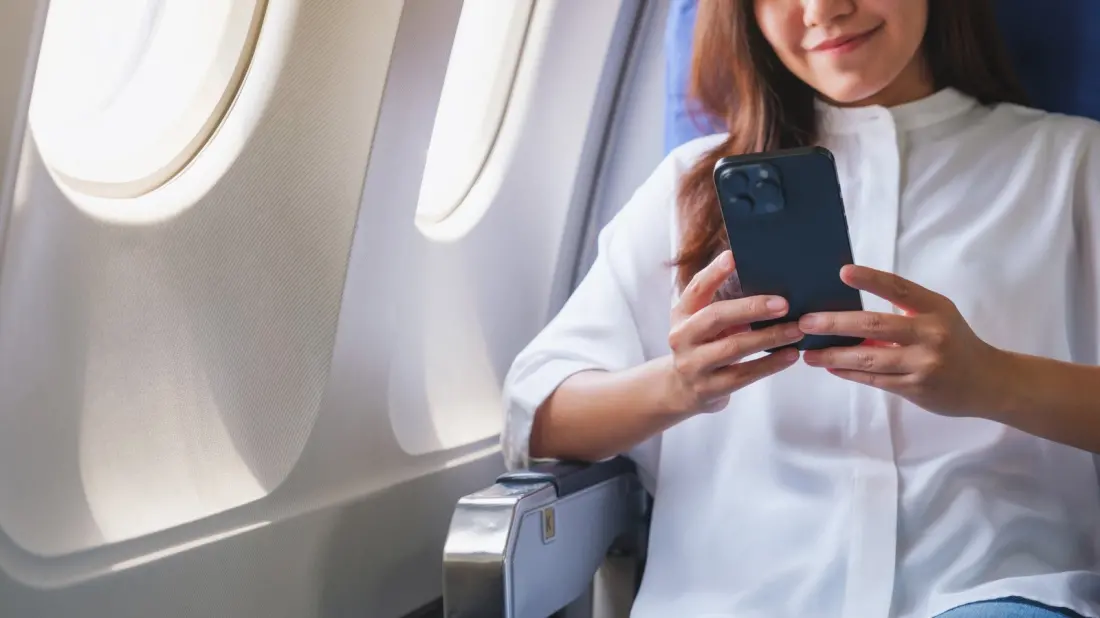
It happens in a second: you're snapping a window-seat photo at takeoff, your phone slips, and it disappears into the crack between seats. The instinct is to wedge a hand down there or shift your seat back to dig it out. Resist that urge. The right move, according to aviation safety guidance, is to call a flight attendant — and the reason is more serious than you'd think.
The problem is the lithium-ion battery inside your phone. If the device gets crushed or compressed — say, by a seat mechanism moving while someone reaches for it — the battery can overheat, spark or catch fire. Aboard a sealed cabin at 35,000 feet, that's a genuinely dangerous scenario, not a minor annoyance. The FAA logged 116 incidents involving cell phones producing smoke, fire or extreme heat between September 2012 and August 2026, with 103 of those happening in the passenger cabin rather than the cargo hold. Batteries in the cabin, in other words, are where most of the trouble occurs.
The risk isn't unique to phones, either. Power banks and other battery-powered gadgets carry the same hazard when damaged, which is why the FAA warns against mishandling them in flight, and why at least one airline has gone as far as banning power banks from flights entirely. New restrictions on power banks are also set to come into force in 2027.
So what actually happens when you flag down crew? Usually, something anticlimactic. Flight attendants can fish out most dropped phones quickly and safely with the seat immobilised — it's a routine ask, and crew would far rather you ring the call button than perform acrobatics in the aisle. If the phone can't be reached without risk, the standard procedure is to leave it where it is and retrieve it once the aircraft has landed. One wrinkle worth knowing: experienced crew say retrieval can be trickier up front, since business and first class seats hide more mechanical components in their housings than standard economy seats do.
Why should travellers care? Because the alternative — quietly contorting yourself to reach the device, or reclining your seat to widen the gap — could turn a lost phone into an in-flight fire. Flight attendants are trained to handle exactly this situation, and batteries are already among the most common causes of onboard safety incidents. Calling for help costs you a minute of awkwardness; retrieving it yourself could cost a lot more. Consider it one of those small pieces of in-flight etiquette that's really just common sense: if something with a battery goes where it shouldn't, let the professionals handle it.