An hour before dawn in Kavvayi, a village 40km from Kannur in North Kerala, a man in crimson and black stands before a mirror, his torso rubbed with ash and wild geraniums pinned to towering headgear. When he steps into the temple courtyard, he is no longer Vinu Peruvannan. He is Kathivanoor Veeran, a warrior-turned-deity — one of 456 theyyakolams performed across this part of Kerala.
This is Theyyam, a ritual art form that runs from mid-October to mid-June each year, with more than 1,000 festivals staged across North Kerala per season, according to tour guide Santhosh Vengara, who has specialised in Theyyam tours since 2010. Visitors are growing every year, and it is easy to see why: few performances anywhere blur the line between performer and divine quite so completely.
At the Sree Kathivanoor Veeran temple, the Kaliyatta Maholsavam — a multi-day, often triennial festival — unfolds over an entire night. It begins with thottam, a sung ballad recounting the deity's human life: the story of Mandhappan, a kalaripayattu warrior cursed by his wife Chemmarathy before a battle, betrayed, killed and said to have been cut into 64 pieces, after which she leapt into his funeral pyre. From death, he becomes the god. Intermediate rituals like vellattam and payattam depict the deity's youth, followed by a second character, Gurukkal Theyyam, the spirit of a tantric minister murdered by the very bodyguards a king had assigned to escort him home.
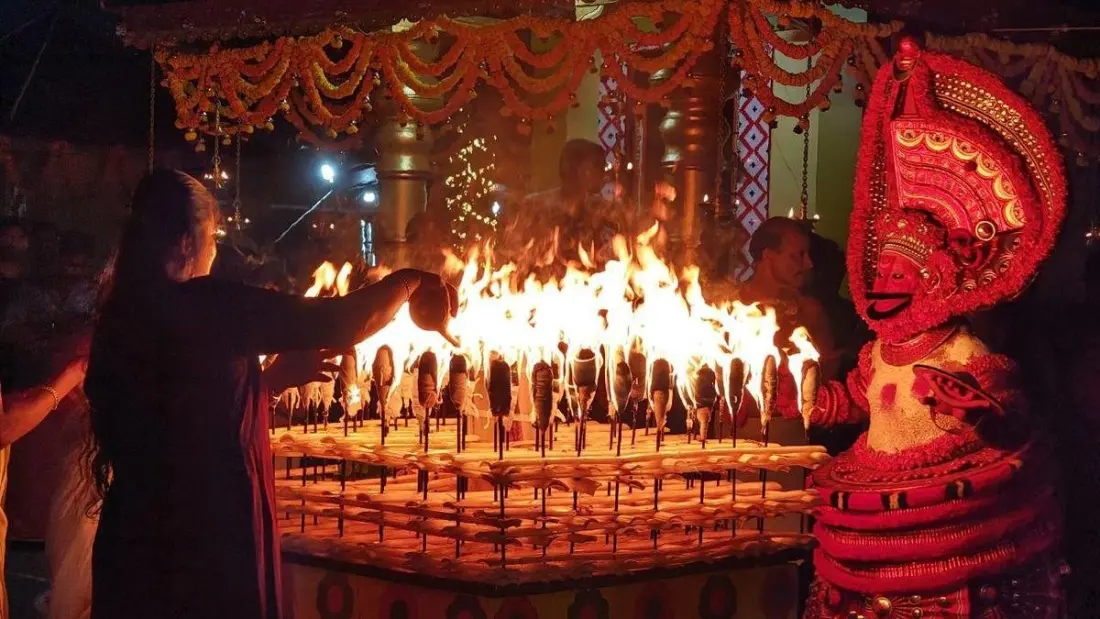
The main event, the kaliyattam, demands patience: the performer's mukhathezhuttu — his makeup and transformation — alone takes four to six hours inside a covered dressing room. When the god finally emerges with sword and shield, devotees press toward the fire to pour oil into the torches, parents carrying infants to the pyre as an act of devotion. The dancer circles the flames until sunrise, then softens to bless the crowd. A rooster sacrifice and a consecration ritual close the night; by then, most tourists have long gone — which, the guides note, is exactly what most of them miss.
The social texture is part of the story. Though Theyyam's roots trace to the caste system, the performances invert hierarchy for a night: performers from historically marginalised communities — Vannan, Malayan, Velan, Mavilan, Panan, Pulaya and Anjoottan — embody the gods, and children from performing families begin training as young as seven. Off-season, these "gods" return to day jobs in carpentry, painting and umbrella repair.
Why it matters for travellers: Theyyam rewards preparation. Go knowing the stories behind the characters, stay past the photogenic fire-walking to witness the quieter rites, and you will experience something closer to living religion than staged culture. The season is long — nearly eight months — but individual festivals are fixed to local temple calendars, so plan around a specific kavu (shrine) rather than dropping in.