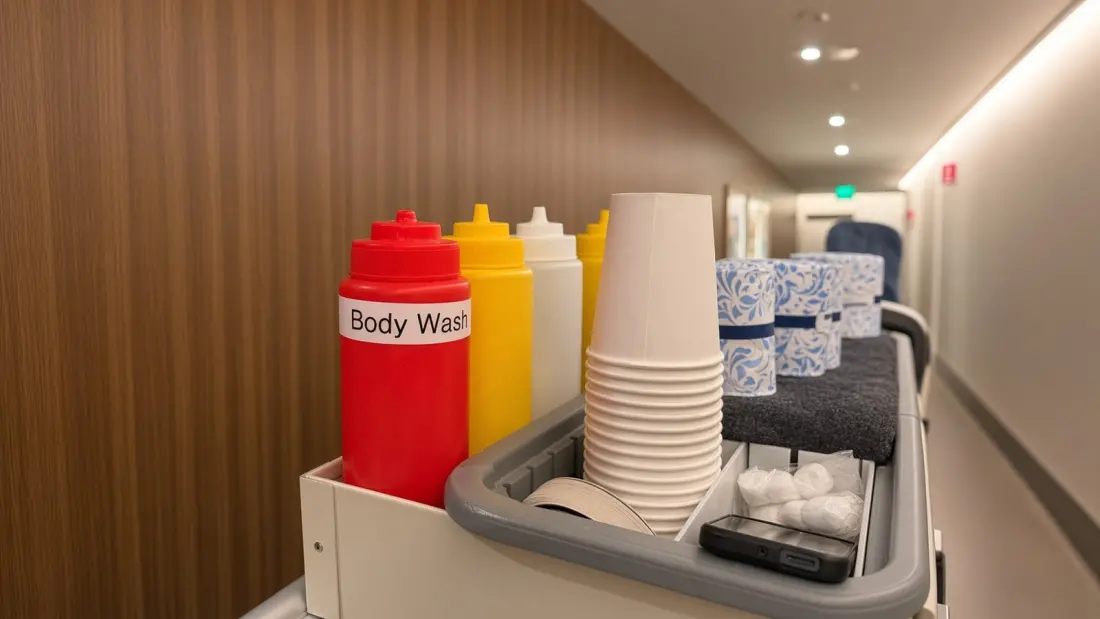
A travel journalist's photo has reignited an old argument about bulk toiletries: on a housekeeping cart at an upscale Boston hotel, unbranded red, yellow and white squeeze bottles — straight out of a fast-food kitchen — sit alongside guest supplies. The red one simply says "Body Wash." Up in the room, the shower dispenser is branded Klur, a boutique skincare label.
The hotel appears to be the Omni Boston Hotel at the Seaport, based on a September review documenting Klur toiletries there, though the source stops short of confirming it. The core issue is the gap between what's on the wall and what's in the bottle. Even if the squeeze bottle genuinely holds Klur Repose shampoo and body wash in Clary Sage and Lavender, decanting a premium branded amenity into a condiment-style container undercuts the whole point of choosing it. And if it doesn't hold the branded product, guests are washing with something the hotel never disclosed.
This isn't a one-off. Readers have photographed similar unlabelled refill jugs on carts at the Hyatt Regency San Francisco and Hyatt Place Phoenix Mesa (the latter alongside a toilet brush resting next to fresh towels). At Hyatt's Wild Palms Hotel in Sunnyvale, California, carts carried bulk DRIFT toiletries while bathrooms displayed Jonathan Adler bottles the hotel advertised. When another outlet followed up, the labels had been removed from the jugs — but the Adler marketing stayed. Most striking, the Suining Marriott in China admitted swapping thisworks amenities for cheaper FORMETURE products; the owner cited cost savings, the hotel insisted the substitute was legitimate, and the guest walked away with 8,000 points.
There are real rules in play. Klur's hospitality line is sold in purpose-built bulk refill containers, not ketchup bottles. Filling a branded bottle with something else raises misbranding questions, refilling under sloppy conditions can breach cosmetic adulteration rules, and in Massachusetts, passing off a cheaper product as the promised one could fall under consumer protection law.
Even taken at face value, the refill trend has practical downsides travellers feel directly. A 2023 German study of 104 hotel dispensers found bacterial contamination in just over 70% of refillable pump dispensers, against roughly 11% of sealed ones. Openable containers can be tampered with, dispensers sometimes sit unlocked, and housekeeping occasionally forgets to fill them at all — a problem you tend to discover mid-shower. There's a quieter loss too: those little branded bottles used to introduce guests to products they'd later buy. Plenty of people discovered Aesop in a Park Hyatt Tokyo bathroom and never went back.
If you care what you're washing with, it's worth a quick look at the dispenser before you shower — checking it's sealed, labelled and actually full — and raising it at the desk if the branding doesn't match the brochure. Hotels get genuine savings and less packaging waste from bulk dispensers; guests just want to know the swap isn't happening twice.
Story first reported by View from the Wing.