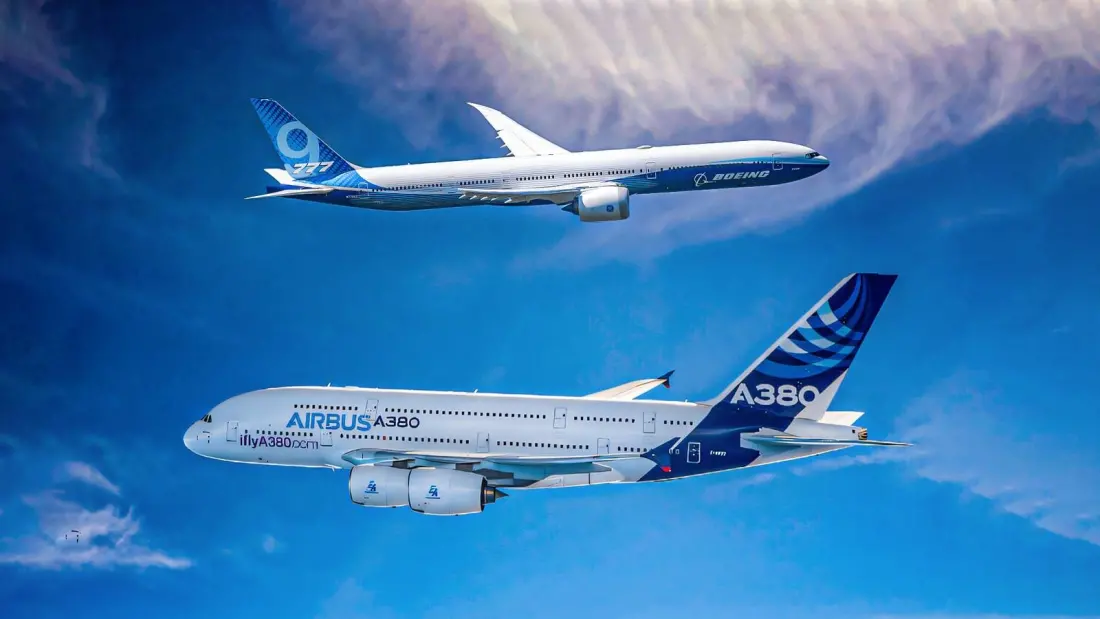
Boeing's upcoming 777X is enormous — the largest airliner the company has ever designed. But is it bigger than the A380, the double-decker that still holds the crown as the largest passenger plane ever built? The answer is: only just, and only in one measurement.
In length, the 777-9 takes it. At 76.73 metres, it becomes the longest airliner ever put into production, edging out the 747-8 and beating the A380 by a full four metres. Interestingly, the older 777-300ER and even Airbus's A350-1000 and A340-600 are all longer than the superjumbo too — partly because the A380's design was optimised for a stretched A380-900 variant that never materialised, a decision that hurt the programme's economics.
Everywhere else, the A380 dominates. Its 79.75-metre wingspan beats the 777-9's 71.75 metres (which folds to 64.84 metres for gate compatibility). The superjumbo's maximum takeoff weight of 575 tonnes dwarfs the 777-9's 351 tonnes, and it stands nearly five metres taller. Its exit limit of 853 passengers also towers over the 777-9's 475.
Why did Boeing build something this big? The 777-300ER was a runaway success, but Airbus's A350-1000 — a clean-sheet composite widebody of similar size — left the ageing 777 exposed. Boeing's answer was a bigger wing for fuel efficiency and a stretched fuselage to cut per-seat costs, plus new GE9X engines, a redesigned 787-style cockpit, and a refreshed cabin with larger dimmable windows, lower cabin altitude, and wider aisles.
That size shapes who's buying. Many 777X customers — British Airways, Cathay Pacific, Qatar Airways, Emirates — also operate the A350-1000, and they plan to use the Boeing for flagship routes with first class, reserving the Airbus for business-class-heavy configurations. Emirates alone accounts for 270 of the type's 500-plus orders, echoing the A380's heavy Middle Eastern skew. The open question: a bigger plane needs better economics to justify itself, since airlines prefer the smaller option when per-seat costs are equal. With entry into service already seven years late, the 777X will be judged on whether it can undercut the A350 where it counts.
For flyers, the practical takeaway is simple: on routes served by the 777X, expect a genuinely new cabin experience — more space in the aisles, dimmable windows, and a calmer cabin altitude — often with a first-class cabin the A350-1000 doesn't have. On the A380, meanwhile, you still get the most space per passenger in the sky, with its two full decks. Both giants offer a noticeably quieter, roomier ride than narrow or standard widebodies, so it's worth checking the aircraft type before booking a long-haul flight.