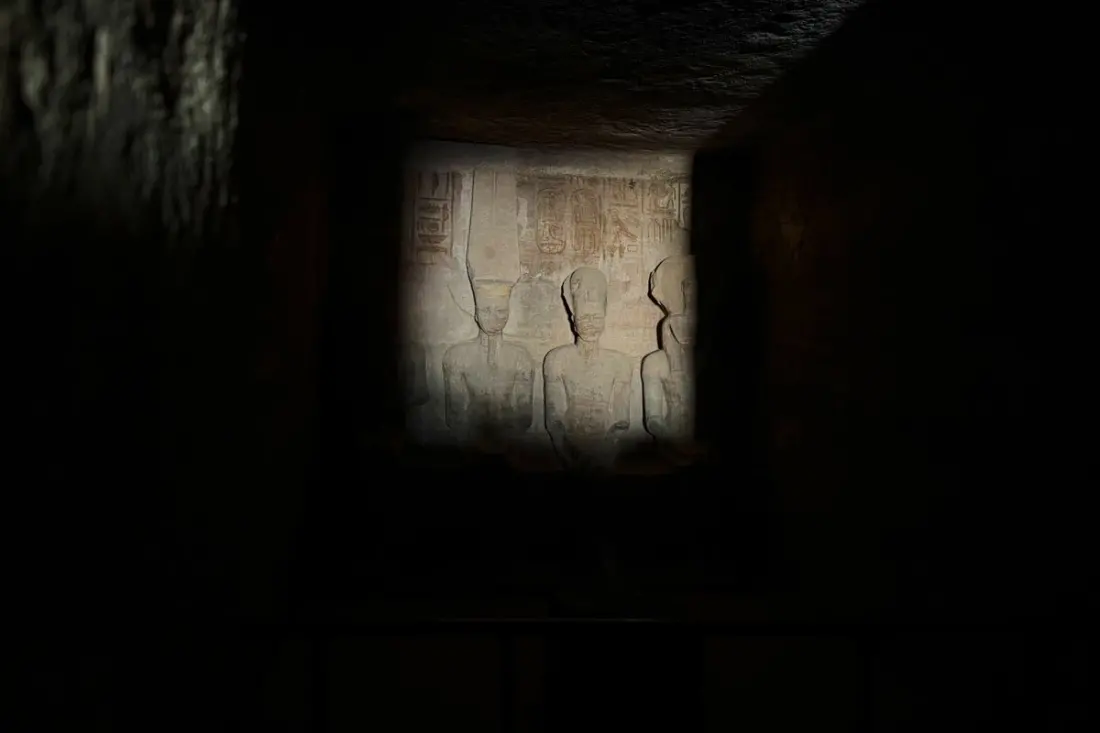
Before dawn on 22 October, a queue of bleary-eyed tourists snaked past the colossal statues outside the Great Temple of Ramses II at Abu Simbel in southern Egypt. Some had slept outdoors to be first inside when, for roughly 20 minutes, a shaft of sunlight pierces 60 metres of darkness and falls on the pharaoh's face.
The phenomenon happens twice a year, on 22 October and 22 February — dates widely linked to Ramses II's coronation and his birthday. As the sun rises, its beam travels deep into the rock-hewn inner chamber to illuminate the seated statues of the pharaoh flanked by the gods Amun-Ra and Ra-Horakhty. A fourth figure, Ptah, sits in shadow — a detail long tied to the precision of the ancient design.
This year's crowd was a mix of international visitors and locals, with guides calling it a celebration as much as a sightseeing moment. Performers in bright traditional dress danced outside to tabla drums, mizmar trumpets and chimes, while inside, visitors packed shoulder to shoulder in near-total darkness, phones raised, waiting for the light to arrive. One first-timer from Atlanta said she came for the giant statues but was won over by the surviving colours in the carvings and hieroglyphics — proof that even jaded travellers find this one lives up to the hype.
There's an engineering footnote that makes the whole thing more remarkable. When the Aswan High Dam threatened to flood the site in the 1960s, a UNESCO-led effort dismantled the entire temple and rebuilt it on higher ground above Lake Nasser. Engineers managed to keep the solar alignment intact, meaning the sun still finds its way into the sanctuary more than 3,000 years after construction.
Why should it be on your list? Because unlike most ancient wonders, this one comes with a fixed appointment. You can visit Abu Simbel any day of the year and still marvel at the four 20-metre statues guarding the facade, but the twice-yearly illumination turns a great sight into a genuine event — complete with festival atmosphere. The trade-off is a very early start: Abu Simbel sits about 280km south of Aswan, and most visitors arrive before sunrise by road, or stay overnight near the site to avoid the dash. If you miss October, February's edition falls in peak Egyptian winter, when southern Egypt is pleasantly warm rather than scorching.
Tips for takers: get there at least an hour early if you want a spot near the sanctuary, keep expectations measured — it's a 20-minute glow, not a laser show — and pair the trip with Aswan's temples or a Nile cruise to make the long journey pay off. The event draws crowds and long single-file lines, so patience is part of the package.