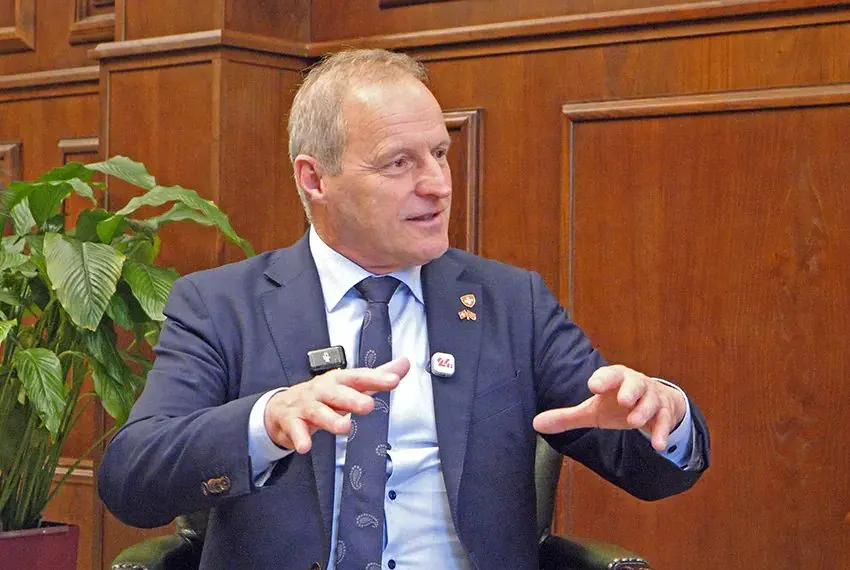
When Pierre-André Page, President of the National Council of the Swiss Federal Assembly, touched down in Bishkek, he brought two hats with him. One was political — he leads Switzerland's powerful lower chamber of parliament. The other was literally musical: Page conducts La Landwehr de Fribourg, a Swiss wind orchestra with more than two centuries of history, which chose Kyrgyzstan for its first-ever performance in Central Asia. The trip came at the invitation of KSB Commercial Bank, a Kyrgyz bank operating with Swiss capital.
In an interview with Kyrgyz news agency 24.kg, Page drew a line between conducting and legislating. Most of his orchestra's players are amateurs, he explained, and getting different instruments to blend is much like getting politicians with opposing views to listen to one another. When a musician plays too loudly, you signal piano; in parliament, the equivalent is reminding a colleague to hear others out.
Beyond the music, the visit carried substance. Page flagged four areas where Switzerland wants to deepen cooperation with Kyrgyzstan: hydropower, natural disaster prevention, finance and agriculture. Swiss experts have worked in the country for roughly 35 years, and a small hydropower plant on the Turgen River is already being built with Swiss money. Page argued that a network of smaller plants beats dependence on a single mega-dam — if one facility fails, the others keep the lights on.
The two countries have more in common than you might expect: both are mountainous, landlocked and exposed to rockfalls, landslides and shifting glaciers. Switzerland's monitoring and early-warning systems for these hazards are among the world's best, and Page suggested they could be adapted for Kyrgyz terrain. He also pointed to dairy farming — his own original trade — as a sector where Swiss cheese and milk expertise could raise incomes in a country he described as full of vast pastures and hardworking people. His framing was deliberately non-prescriptive: Switzerland offers experience, not a model to copy.
So why should a traveller care? Because steady Swiss investment in small hydropower, mountain safety and rural development tends to make a destination easier and safer to explore — better rural infrastructure, more reliable electricity in remote valleys, and reduced landslide risk on the routes trekkers love. And if a 200-year-old Swiss orchestra is now performing in Bishkek, the country's cultural calendar is clearly opening up to the wider world. Kyrgyzstan remains one of Central Asia's most approachable destinations: visa-free or visa-on-arrival for many nationalities, spectacular alpine scenery around Issyk-Kul and Song-Kul, and a nomadic heritage you can experience first-hand in a yurt stay. If a senior Swiss parliamentarian can see the potential, it might be time to see it before the crowds do.