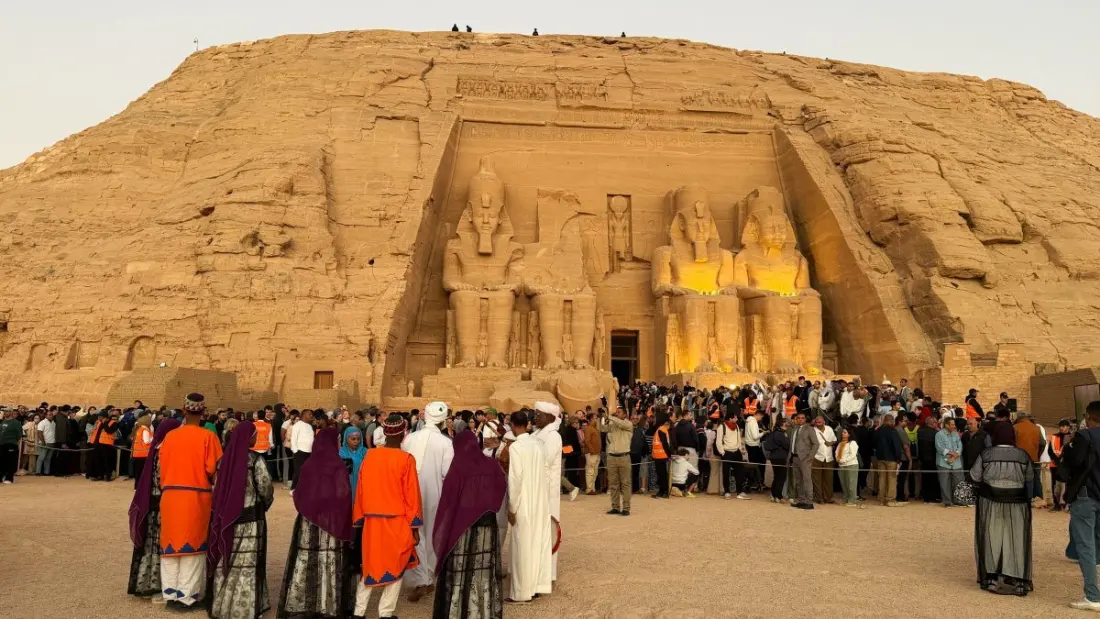
At dawn on 22 October, several hundred bleary-eyed travellers and locals crowded outside the Great Temple of Ramses II at Abu Simbel in southern Egypt — some had camped there overnight — waiting for a solar show first staged more than 3,000 years ago.
Twice a year, on 22 October and 22 February, the rising sun sends a narrow beam about 60 metres into the temple's dark inner sanctuary, lighting up a statue of the pharaoh flanked by the gods Amun-Ra and Ra-Horakhty. The illumination lasts roughly 20 minutes. The dates are believed to mark Ramses II's ascension to the throne and his birthday, and the effect depends entirely on the temple's precise alignment with the sun.
It nearly didn't survive. In the 1960s, engineers dismantled the entire temple block by block to move it above the rising waters of Lake Nasser behind the new Aswan High Dam — and they deliberately preserved the solar alignment. That's why the light still finds its way in today.
The modern scene is part spectacle, part pilgrimage. Visitors queued single-file in the dark clutching phones and selfie sticks, while colourfully costumed dancers and musicians performed outside to tabla percussion, chimes and the brassy wail of mizmars, an ancient Egyptian trumpet. The colossal statues looming over the Nile made even a large crowd look small. One first-time visitor from Atlanta, Janice Souudi, came for the giant statues and left most impressed by something else: the surviving colours in the carvings and hieroglyphics.
For travellers, this is one of the few ancient wonders that comes with a fixed appointment. If you want to see the inner sanctum lit by sunlight rather than electric bulbs, you have two windows a year. Expect serious crowds at dawn, and book accommodation in nearby Abu Simbel village or plan a pre-dawn transfer from Aswan (roughly three hours by road) to be in position early. The same alignment event recurs on 22 February, so if Egypt's winter suits you better, that's your slot.
Even outside the sun dates, Abu Simbel rewards the trip: the scale of the twin temples, the vivid pigment still clinging to some interior carvings, and the sheer story of the rescue relocation make it one of Egypt's most memorable detours. Combine it with a Nile cruise between Luxor and Aswan, or add Philae Temple and the High Dam on an Aswan day tour. It's a long way to go for 20 minutes of light — but ask anyone standing in that darkened chamber when the beam hits the pharaoh's face, and they'll tell you it's worth it.