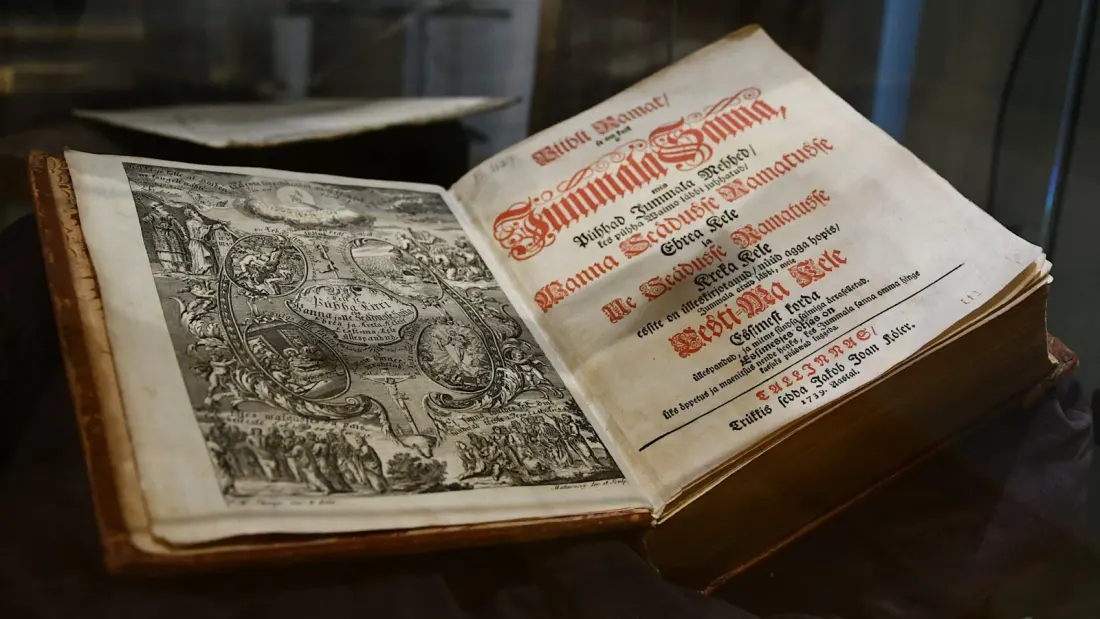
In 1739, a book called Piibli Ramat rolled off a press in Tallinn. It was the first complete translation of the Bible into Estonian, and few books have done more to shape a country's identity. Nearly 300 years on, it's a story worth knowing for anyone travelling to Estonia — because the language you'll hear on Tallinn's streets owes its written form to this single publication.
Before the Bible appeared, Estonian was essentially a peasant language. The nobility, clergy and merchants were largely Baltic German and spoke German; anyone with social ambitions had to switch languages. Written Estonian existed in fragments — a 1535 catechism survives only in pieces — but there was no agreed standard. North Estonian and South Estonian had developed as rival written varieties, each with its own traditions.
The translation took decades. Swedish-era reforms pushed religious instruction in Estonian, and parish schools were mandated in 1686. The New Testament came out in South Estonian in 1686 and North Estonian in 1715, but the Old Testament stalled repeatedly. The pastor who finally saw the whole project through was Anton Thor Helle, born in Tallinn in 1683. He didn't do it alone — more than a dozen pastors contributed — but he led, edited and published the finished work in 1739. The Old Testament was translated fresh from Hebrew, while the New Testament drew on an earlier version influenced by Luther's German Bible.
The choice of North Estonian settled the contest between the two varieties and made Tallinn's regional tongue the basis of the standard language. South Estonian didn't vanish — Võro is still spoken today and is often classed as a separate regional language — but the written standard that grew from Helle's Bible carried Estonia through the 19th-century national awakening, independence, occupation and independence again. It remained the official Bible until a new translation appeared in 1968.
The book also fed a reading revolution. By around 1800, over half the peasantry in Livonia could read, mostly through religious texts, hymnals and almanacs. From there came newspapers, then literature — the national epic Kalevipoeg and the first song festival in 1869 all grew in a society where reading Estonian had become normal. Today roughly a million people speak the language, and Estonia's constitution explicitly obliges the state to preserve it.
Why should a traveller care? Because Estonia is one of Europe's most distinctive small-nation stories: a language that survived German rule, Russification and Soviet pressure to become the official tongue of a modern EU state. Knowing the 1739 Bible's role adds real depth to a visit — whether you're browsing the Tallinn Old Town where the book was printed, exploring the Võro region in the south where a rival linguistic tradition lives on, or simply noticing that Estonian sounds nothing like its neighbours.