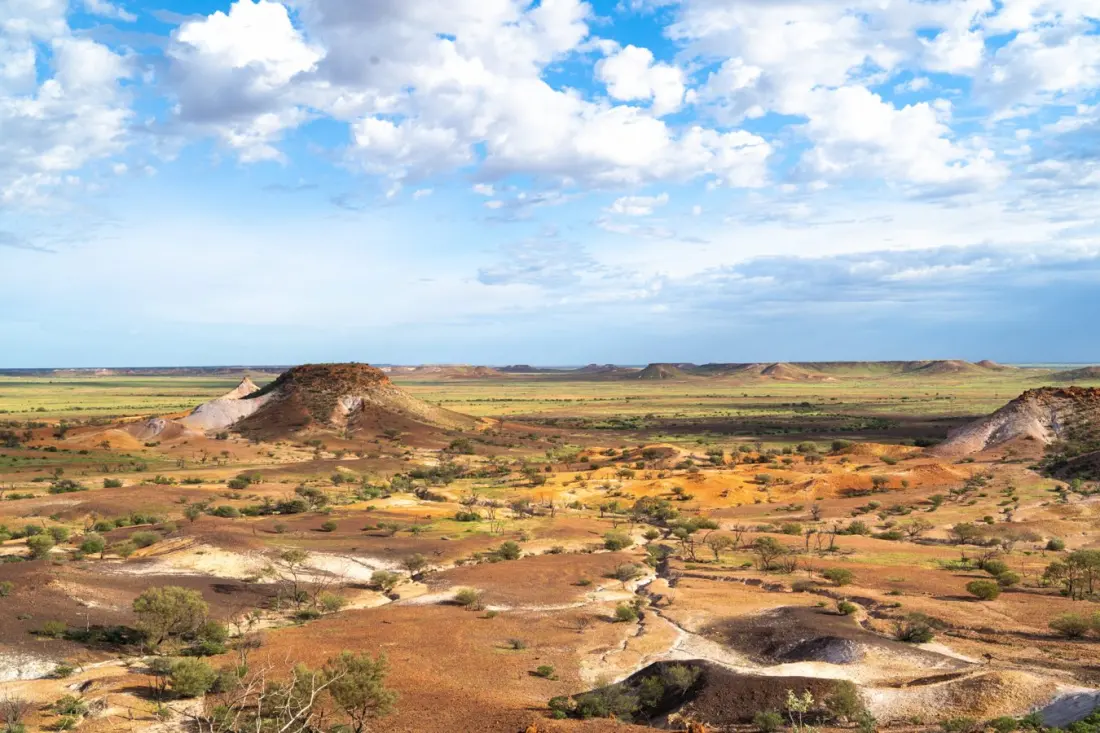
Coober Pedy is famous for one thing above all: opal. But the strangest and most wonderful detail about this outback town is that roughly half its residents live underground. Summer temperatures here can push past 45°C, so locals have tunnelled homes, churches, restaurants and bars into the hillsides. These 'dugouts' hold a steady 23°C year-round, and their walls still carry the tool marks of the miners who carved them. The Traditional Custodians, the Antakirinja Matu-Yankunytjatjara people, know the place as Umoona.
Above ground, the landscape looks almost alien, stacked with mounds of excavated rock from more than 1.5 million open mine shafts, some up to 30m deep. Visitors can try their luck 'noodling' – fossicking through mining waste in a free public area on the town's eastern edge – or browse opal chips at spots like Josephine's Gallery, which doubles as a kangaroo orphanage and shows work by First Nations artists.
The real revelation of inland South Australia, though, is what lies far deeper in time. At Nilpena Ediacara National Park on Adnyamathanha country, geologist Reg Sprigg discovered fossil imprints in 1946 that turned out to be the earliest evidence of complex multicellular life on Earth – a find so significant it defined the Ediacaran geological period. Inside a retired woolshed, visitors stand on a fossilised seafloor about 550 million years old, and one reconstructed 9m slab, 'Alice's Restaurant Bed', holds more than 200 individual fossils, brought vividly to life by a projected audio-visual show. You can even touch them.
A few hours north-east in the northern Flinders Ranges, Arkaroola Wilderness Sanctuary offers 63,000 hectares of folded granite ranges, yellow-footed rock-wallabies, ridgetop 4WD drives to Sillers Lookout and scenic flights over Lake Frome – rock here dates back 1.6 billion years. After dark, Arkaroola becomes one of only two International Dark Sky Sanctuaries in Australia, with observatories capturing live deep-sky images and Adnyamathanha astronomy sessions explaining how the Emu in the Sky signalled the season for collecting emu eggs.
Add Sacred Canyon (Yura Malka) in Ikara-Flinders Ranges National Park, where engravings between 6,000 and 18,000 years old record where to find water and food, and the depth of human history here becomes staggering: Adnyamathanha presence in the Flinders has been carbon-dated to at least 50,000 years. A 2016 dig even found megafauna bones alongside evidence of Aboriginal people – the only such site on the continent.
Who's it for? Travellers who want their outback trip to be more than red dirt and sunsets. This is geology, palaeontology and living Aboriginal culture layered into one route, best tackled on a guided itinerary – Intrepid's 10-day South Australia Outback Tour covers the lot, and a local guide earns their keep when rain closes tracks like the Oodnadatta.
Story via Australian Geographic.