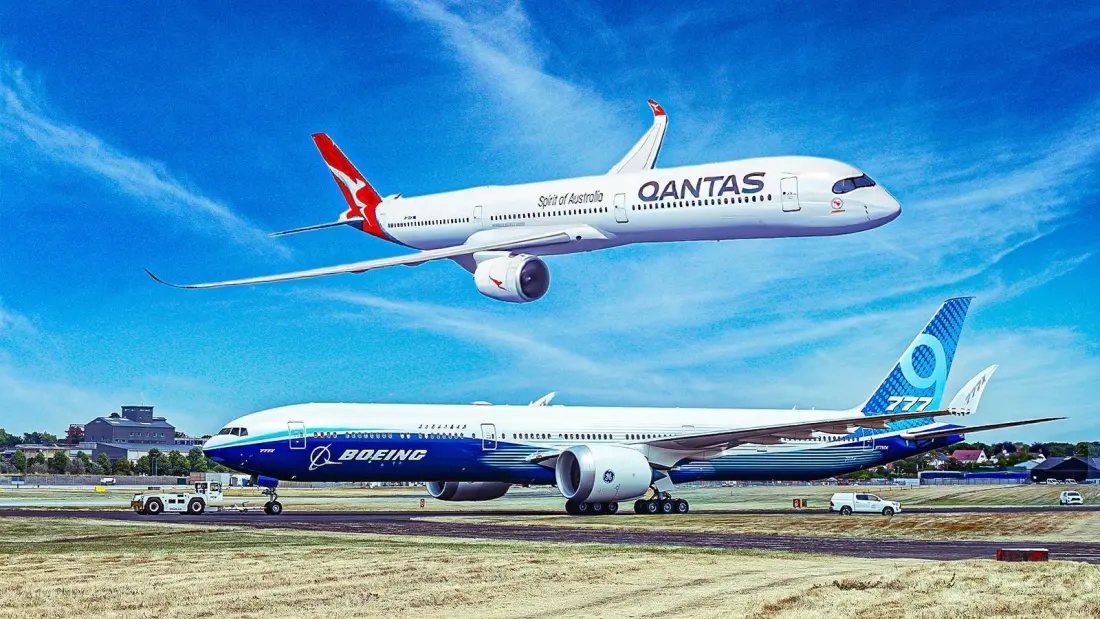
The world's longest commercial flights are finally happening. From 2027, Qantas plans to fly nonstop from Sydney to London and New York under its Project Sunrise programme, and the jet it has chosen is the Airbus A350-1000ULR — a heavily modified version of the A350-1000 built for one job: staying airborne for around 22 hours at a stretch.
The ULR gets an extra rear centre fuel tank and upgraded fuel systems, pushing its estimated range beyond 9,700-10,000 nautical miles (18,000-18,520 km). To carry all that fuel and still perform on record-length sectors, Qantas is configuring it with just 239 seats — a deliberately low-density, premium-heavy cabin. There's also a dedicated Wellbeing Zone onboard, with features designed to soften the effects of jet lag on flights that cut up to four hours off today's one-stop itineraries.
Boeing's answer to the long-haul market, the 777X, is a different animal. The 777-8 tops out around 9,500 nautical miles (17,594 km), while the longer 777-9 manages roughly 8,000 nautical miles — impressive, but short of the ULR. Where the 777X wins is capacity: two-class layouts of up to 426 passengers on the 777-9, with folding wingtips so the giant wing still fits standard airport gates. It's built for dense hub-to-hub routes, not marathon point-to-point flights. Its order book is much bigger too — Emirates alone has committed to 270 — but the programme has slipped around seven years, with first deliveries now targeted for 2027, and 33 orders have been dropped along the way. The A350-1000, by contrast, has been flying for years, with 373 orders and 120 delivered as of October 2026, plus a fresh eight-plane order from Air Canada.
For travellers, the practical upshot is simple: from 2027, Australia's east coast becomes a one-flight destination from London and New York for the first time. Qantas has 12 of the ULRs on order for the job. Anyone booking these routes can expect a smaller, more spacious cabin than a typical long-haul jumbo run, plus significantly less total travel time. The trade-off is likely to be premium-heavy pricing and tighter recovery buffers when weather or delays hit — a 22-hour mission doesn't reschedule easily.