
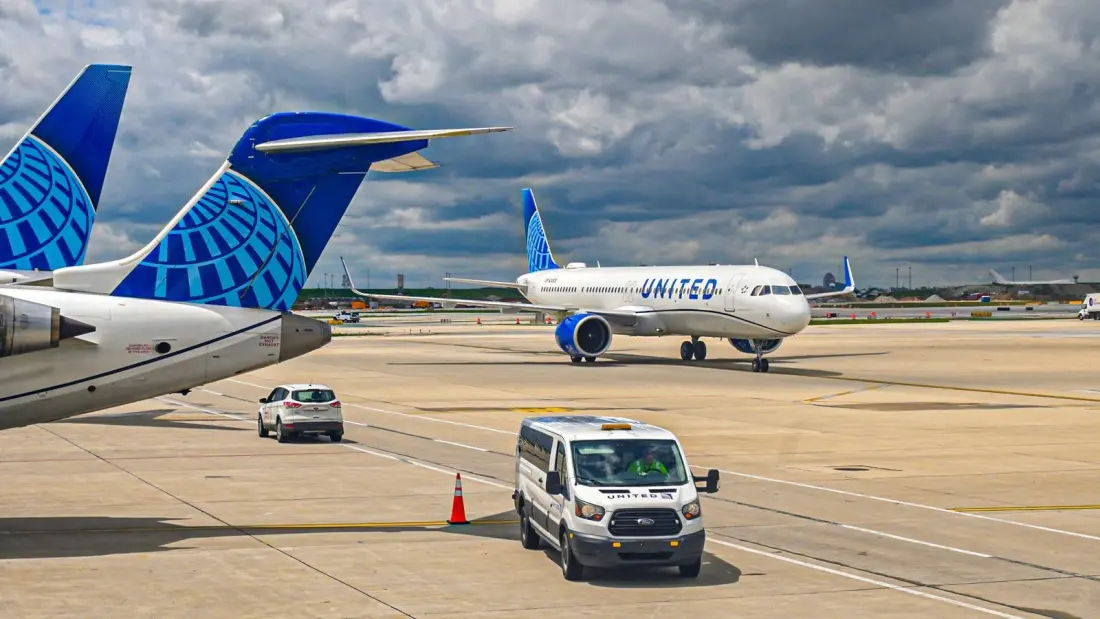
United Airlines is advertising the biggest single-carrier schedule ever flown at Chicago O'Hare this year — up to 650 daily flights to 222 nonstop destinations, 47 of them international. The twist is that it's happening while the FAA has cut O'Hare's total daily operations ceiling by 12%, down to 2,708 movements, from the roughly 3,080 carriers had filed for summer 2026. The cap, first imposed in April and extended through October 2027, exists because of the multibillion-dollar ORDNext construction program and air traffic control constraints.
United had originally wanted 750-780 daily departures. With the daily movement ceiling fixed, the airline is flying bigger aircraft instead — the practice known as upgauging. Under its United Next fleet plan, it has been pushing 50-seat regional jets toward just 10% of North American departures while raising average seats per flight from around 104 in 2019 to 134 now. At O'Hare, that means Boeing 737s and Airbus A320s replacing Bombardier and Embraer regionals wherever demand allows, since a 50-seater burns the same slot as a 180-seat narrowbody.
The cost falls on small Midwest cities. OAG data shows United cut 9,088 departures from its June-August O'Hare schedule versus its original filings — a 7.6% reduction. Routes to Champaign and Bloomington in Illinois, Kalamazoo, Lansing and Marquette in Michigan, La Crosse and Wausau in Wisconsin, plus Tri-Cities, Erie, and Rochester, Minnesota have been scrapped, along with planned seasonal Guadalajara service. Ten to eleven small markets in all lose O'Hare service, though United reportedly expects to restore them once the cap lapses in 2027. New flights that survived were pushed into early mornings and a late-evening bank, because O'Hare's peak hours were already saturated and runway construction limits simultaneous pushbacks.
There's a rivalry underneath it all. O'Hare's 2018 lease now reallocates gates on a use-it-or-lose-it basis tied to flying volume, and United won five gates from American in the October 2025 reallocation — taking its share to roughly 42% versus American's 30%. CEO Scott Kirby framed the schedule build-out as part of that fight. But the strategy showed strain on August 9, when a ground stop helped set a global delay record: United canceled 52 flights that day against American's 10, with near-identical delay counts, and it has led US carriers in cancellations more broadly. Travelers connecting through O'Hare this year should build generous buffers, especially at peak periods, and anyone in the affected small cities should check alternative airports or expect these routes to return only after late 2027. United is hiring about 2,500 extra O'Hare staff and opening new United Club and Polaris lounge space to cope.
Full credit to Simple Flying for the original reporting.