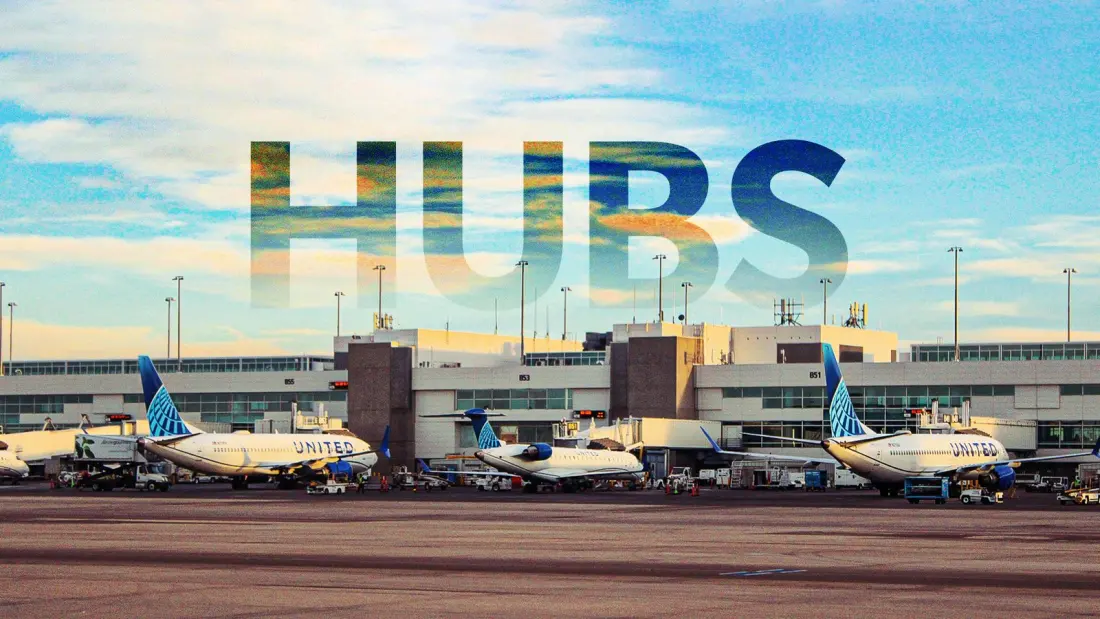
If you're flying United domestically this year, the hub you pass through matters more than you might think. A data-driven ranking of the airline's seven biggest US bases shows a wide gap between the smoothest and most chaotic operations, and the reasons range from weather and runway design to federal rules.
Los Angeles tops the list. United ran around 30,000 flights there last year with an 82.5% on-time arrival rate and just a 0.50% cancellation rate, though it has slipped to about 79% in 2026. The key is that LAX works mostly as a point-to-point market rather than a connection factory, so one late inbound plane doesn't trigger a chain reaction of missed flights. Four parallel runways and a $573 million Terminal 7 renovation help planes turn around quickly.
Washington Dulles is the quiet overachiever, holding steady at 82% on-time in both 2025 and 2026. Four runways that never intersect let controllers keep traffic flowing even in rain and cloud, and United increasingly flies 787-9 Dreamliners on transcontinental routes, whose lower cabin altitude and better humidity help with jet lag.
Houston Intercontinental takes third with 80.6% on-time last year and a lean 0.55% cancellation rate across more than 74,200 flights. Five runways and a generous taxiway grid mean it often absorbs re-routed traffic when storms shut down Chicago or Newark. Denver, United's busiest hub with roughly 108,000 flights in 2025, manages a network-best 0.41% cancellation rate despite the challenge of hot, thin air at 5,434 feet that strains engines on summer afternoons.
Then things get rough. San Francisco dropped from 79% to 73% this year after the FAA ended its parallel-landing exemption, meaning Bay Area fog now cuts arrival capacity from 60 to about 30 planes an hour. Newark has the airline's highest cancellation rate (2.3% last year) thanks to a tight airfield, a strict hourly flight cap and runway construction. Chicago O'Hare is last: on-time performance fell to 71%, evening departures dip below 70%, and tarmac queues can burn over 1,000 pounds of fuel an hour per waiting jet.
Why it matters: if you have a tight connection or a fixed event at your destination, booking through Houston, Dulles or LA is statistically safer than gambling on O'Hare or Newark. And if you must connect in Chicago, book an early flight — before 8 AM, roughly 90% of departures leave on time; by evening rush, that drops sharply.