Some flowers are more than pretty — they prop up entire local economies and centuries-old traditions. Portuguese photographer Teresa Freitas has spent recent years documenting two of the most striking examples, in Morocco's High Atlas and Japan's Yamagata Prefecture, and her work doubles as a tempting pitch for off-season, culture-first travel.
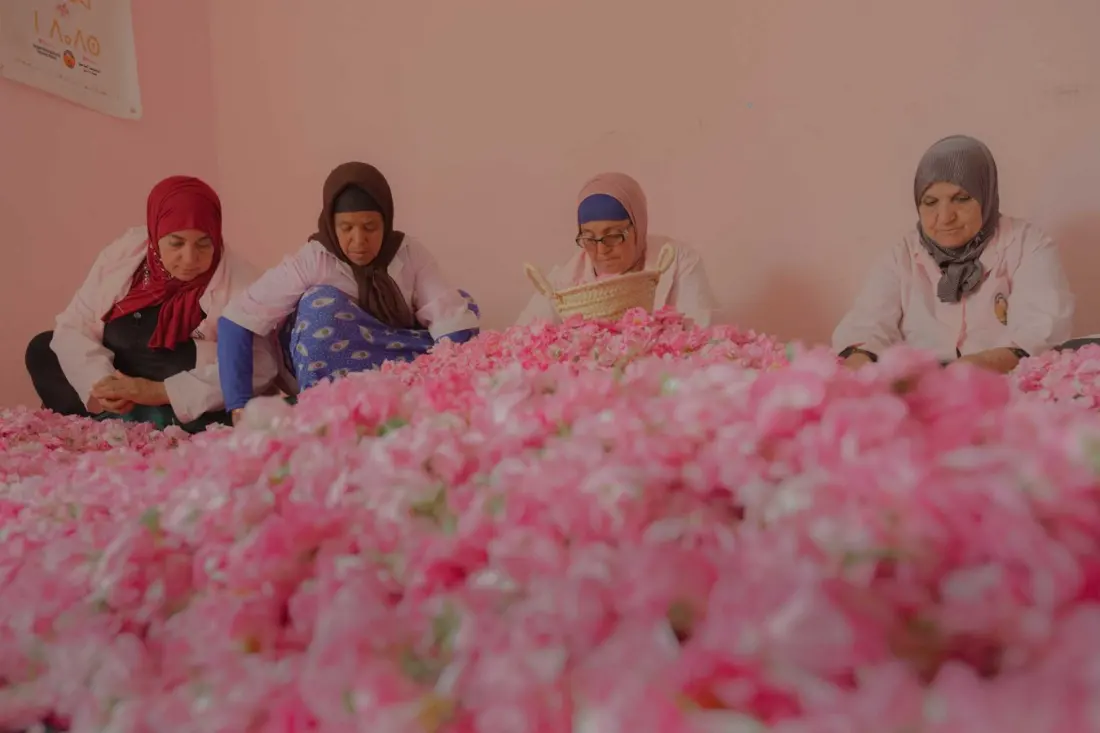
In southern Morocco, the Assif M'Goun River feeds a desert oasis known as the Rose Valley, one of the world's biggest sources of damask roses. Freitas first arrived in 2023 during the April harvest, when families rise at 5am to hand-pick the blooms while they're still soft with morning dew. The petals are then weighed, sold and hydrodistilled into essential oils and perfume using methods that trace back to 10th-century Persia. For the Amazigh (Indigenous Berber) communities here, roses mean beauty and purity, but more practically they're a livelihood. Freitas worked closely with Hafsa Chakibi, a female flower farmer who runs the socially minded distillation company Flora Sina, returning to the valley multiple times to capture the full cycle from field to still.
Her second stop was Takase, a quiet town in Yamagata Prefecture on Japan's main island of Honshu, roughly four hours by road from Tokyo. It's the heart of benibana — safflower — country, where fields of orange, pom-pom-like blooms conceal a blood-red centre. That crimson pigment, carthamin, once dyed kimonos and coloured the rouge worn by geisha, and in the 17th century the flower traded at extraordinary prices, reportedly worth ten times its weight in gold. Trade ships carrying the petals down the Mogami River were said to leave a fiery streak in the water.
Today benibana has little commercial value, which is precisely what makes Takase's July Safflower Festival so charming: over several weekends, volunteers at the local community centre harvest around 20,000 flowers by hand, then pickle, pound and mix them with acidic fruit like plums to coax out the vivid red dye. Freitas spent months there as artist-in-residence, photographing the people rather than just the process — tradition as something alive, not preserved in amber.
Why should travellers care? Both destinations reward timing and curiosity. Morocco's Rose Valley is best caught during the brief April bloom, ideally as part of a High Atlas trek that ends in rose-scented villages rather than on a coach tour. Takase's festival falls in July, and Yamagata remains well off the usual Tokyo–Kyoto tourist track, offering mountain scenery, tea plantations and genuine community celebration. If you time either trip right, you're not watching a show for tourists — you're glimpsing harvests that have shaped these places for centuries.
Freitas's images from both trips are collected in her new photo book Flower(s) — Vol. 1, and she shares work on Instagram at @teresacfreitas.