
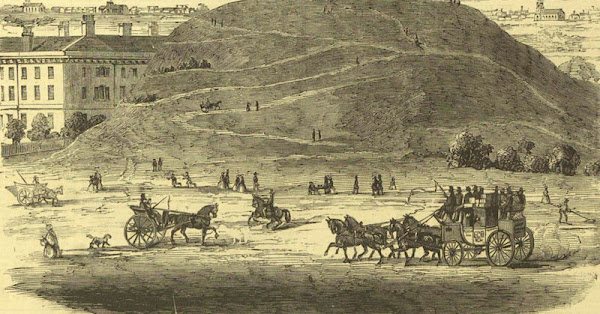
For roughly two centuries, a hill stood in London's East End where no hill should have been. Whitechapel Mount, rising some 70 to 80 feet above the flat streets near Whitechapel and Shadwell, appeared on 18th-century maps, served as a landmark for travellers, and offered sweeping views over the city, the Thames and the growing docks to the east. It even had trees on its slopes and a small building at the summit. By the mid-1800s it was gone — levelled as land values soared — and today most Londoners have never heard of it.
What makes the mount genuinely intriguing is that nobody knows how it formed. The leading theory is prosaic: it was a laystall, one of the city's official rubbish dumps, where 17th-century London piled street sweepings, domestic refuse, brewery waste and human waste. Like modern landfills, these heaps ran a recycling economy — poor families sifted the refuse, and coal ash was prized as a brickmaking ingredient. An Old Bailey record from 1809 notes that ash extraction for the brick trade had already shrunk the hill considerably.
Other theories are more dramatic. Some historians argue the mound grew from rubble carted east after the Great Fire of 1666. A grimmer tradition holds that it capped a plague pit from London's epidemics, including the Great Plague of 1665 — a claim given support by Joseph Moser, who inspected the site in 1802 and reported human bones in the excavated strata. A fourth idea links it to the Civil War: Parliament's ring of some two dozen earthen forts around London, completed by 1643, apparently included a nine-angled fort at Whitechapel, described by the Scottish traveller William Lithgow. But records never clearly tie the mount itself to those defences.
When the hill was being dug away in the early 19th century, crowds of Londoners flocked to scavenge. Finds reportedly included Roman coins, a silver tankard, and — fuel for the fire-debris camp — a carved boar's head with silver tusks said to have hung at the Boar's Head Inn in Eastcheap, an inn that definitely burned in 1666.
Modern archaeology hasn't settled it. Excavations near the Royal London Hospital in the 1990s uncovered a wide 17th-century ditch that seemed to match the Civil War defences, but a follow-up dig in the early 2000s found no fortification — instead revealing Christian-style burials, coffins laid east-west, predating the hospital's known burial ground. The likeliest conclusion: the mount wasn't one thing but an accumulation of many — a burial site, a rubbish heap, fire debris, possibly an earthwork, layered over centuries.
For a traveller, it's a reminder that London's lost landmarks often hide in plain sight. Walk Whitechapel Road today between Aldgate and the Royal London Hospital and you're crossing a spot that once held one of the city's tallest man-made features. Pair it with a wander through the East End's layered history — the old docklands, Wilberforce-era streets and hospital grounds — and the flat horizon reads rather differently.