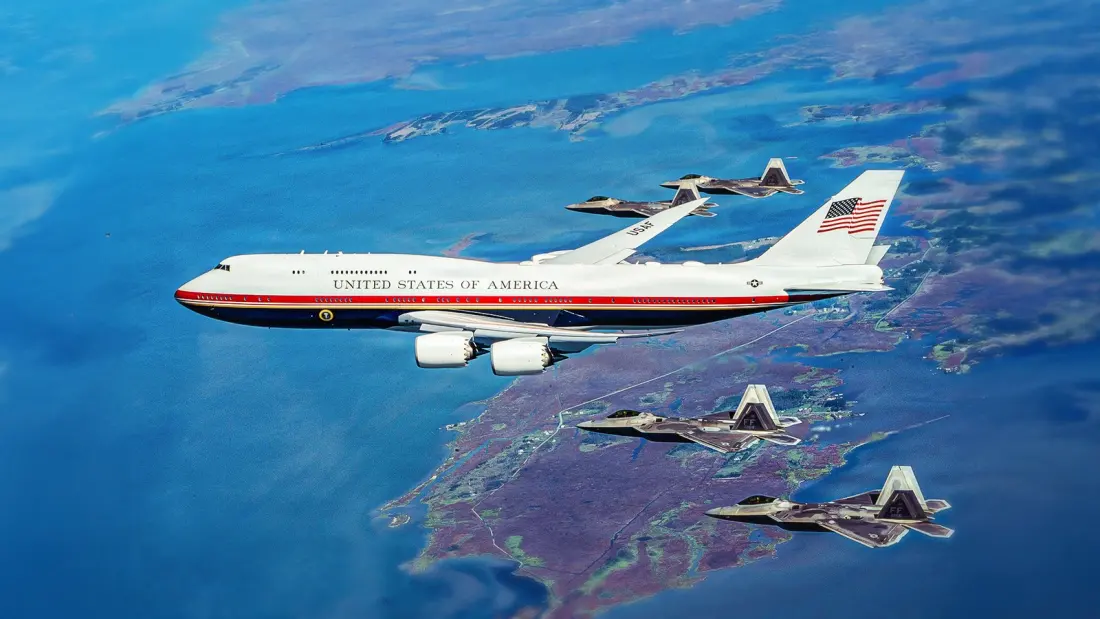
Commercial pilots run a well-oiled pre-flight routine: briefing the flight plan, walking the aircraft, loading data into the computer, checking weights. The crews who fly the US President go considerably further. A look inside the process behind Air Force One — the callsign for any US Air Force aircraft carrying the President, most famously the two Boeing VC-25As — shows just how much extra work goes into moving one passenger safely.
Before every flight, VC-25A crews coordinate with ground teams to sweep the apron and runway for debris, confirm the aircraft's onboard security and defence systems are working, and liaise with air traffic control to guarantee the surrounding airspace is clear and the jet gets priority handling. They also review aerial refuelling procedures — the VC-25A can top up its fuel mid-air and stay aloft until food and water run out, though this has never been done with the President aboard.
The time commitment is striking: pilots typically arrive three to four hours before departure, working with the US Secret Service to secure the aircraft and airport, running inspections and systems tests, and rehearsing emergency procedures. Despite all that, crews train to launch with as little as an hour's notice if needed.
Getting this job is nearly as demanding as doing it. Pilots need USAF experience on heavy multi-engine aircraft, generally at least 2,500 flight hours, and usually cut their teeth at the 89th Airlift Wing at Andrews Air Force Base flying VIP transports like the C-32 and C-40. Senior leadership handpicks candidates, who face interviews, psychological screenings and simulator checks. The final hurdle is 'Yankee White' clearance — an ultra-strict vetting process with background interviews reaching family, neighbours and former teachers, plus a spotless criminal and financial record. It can take up to a year.
The logistics are equally elaborate. Presidential trips start with a short Marine Corps helicopter hop — about six to ten minutes — from the White House South Lawn to Andrews. On arrival at the destination, the airport typically shuts down, and motorcade vehicles or helicopters are flown in ahead of time aboard a C-5 Galaxy. The President always boards last, and doors close before engines start.
Not every mission uses the famous 747s. When runways are too short for a VC-25A — or on sensitive trips — the President takes the smaller C-32A, a 757 derivative. That's how Joe Biden reached Ukraine in February 2023, flying under the callsign 'SAM060' with a refuelling stop at Ramstein in Germany before continuing by train from Poland.
Fleet changes are on the horizon. The two VC-25As date from the early 1990s and are ageing and costly to maintain, so replacements based on the 747-8 have been ordered for around 2028 after repeated delays. In the meantime, a 747-8 business jet gifted by Qatar in 2025 — the VC-25B Bridge — entered service in July 2026 as an interim aircraft, though it lacks many of the defensive features of the planes it supplements.
For travellers, it's a rare glimpse of what it takes to run the most scrutinised flight in the world — and a reminder that even an hour-long hop can involve months of preparation.