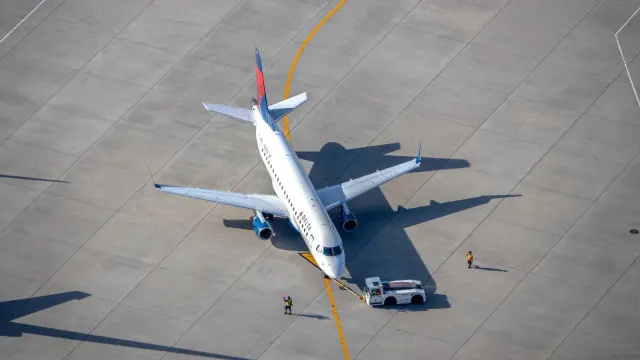
The Boeing 767 was built for long hauls, but its last act is playing out on short ones. Delta Air Lines has been putting its 767-400ER on domestic sectors like Atlanta to Las Vegas and New York JFK to San Diego, while Icelandair has scheduled 767-300ERs on short European hops including Reykjavík to Stockholm. The logic isn't nostalgia — it's about seats.
Delta's Atlanta–Las Vegas return is a good example. A daily 767-400ER came back to the route on March 29, 2025, having last flown it in December 2023, with a second daily rotation briefly added in late April. The flight is only about four hours, so the aircraft's transatlantic range is irrelevant. What matters is capacity: Delta's 767-400ER seats 238 passengers across Delta One (34), Premium Select (20), Comfort+ (28) and Main Cabin (156). The Delta One seats convert into 77-inch fully flat beds, meaning travellers can buy a lie-flat business-class product on a domestic flight — normally something reserved for international routes.
For passengers, that's the headline perk. On leisure-heavy routes with strong demand, a widebody means more availability and a shot at premium seating without crossing an ocean. For the airline, it's a way to concentrate seats on selected departures, protect premium inventory for corporate customers, and keep an older, already-paid-for airframe productive instead of idle.
Icelandair is running a version of the same playbook on a tighter clock. Its 767-300ERs appear on Reykjavík–Stockholm twice weekly through December 13, 2026, alongside wider 2026 deployments to Boston, Copenhagen, London Heathrow and Paris. Passenger 767 operations end in early January 2027, with the final arrival in Reykjavík on January 6 — a controlled wind-down rather than a long-term commitment.
Japan demonstrated the model decades ago. Dense domestic demand and scarce airport slots led ANA and JAL to run 767s on short sectors; Tokyo Haneda to Sapporo sees up to ten daily 767 flights, roughly 78,000 seats in a single month. When you can't add departures, adding seats per departure is the only way to grow.
The caveat is cost. A 767 burns more fuel and needs more ground resources than a modern narrowbody, and the 737 MAX and A321 families have narrowed the gap. But the widebody still wins where demand is strong enough to fill it — and where a twin-aisle cabin and lie-flat seats can command higher fares.
For travellers, this is a genuinely useful quirk to know about. Book the right Delta domestic route and you might score a flat-bed Delta One seat for a fraction of long-haul pricing. And if you want one more flight on a passenger 767, Icelandair's final rotations are the last scheduled chance to fly the type in Europe before it retires in January 2027.
Credit: Simple Flying