American Airlines is one of the few big global carriers with no Airbus A350s on board — and the story of how that happened is a useful window into how airline fleets actually get built.
The A350 is widely seen as the long-haul jet of choice: largely carbon-fibre composite, powered by Rolls-Royce Trent XWB engines, and burning noticeably less fuel than older widebodies. Carriers like it because it comes in two sizes (the -900 for thinner long routes, the -1000 for dense trunk routes), shares training and maintenance across both, and has a strong reputation for passenger comfort thanks to better cabin humidity and pressurisation. Delta, United's rivals elsewhere, and most major international airlines have built their widebody plans around it.
American didn't choose to skip it — it inherited the order. US Airways committed to 20 A350s back in 2005, expanded to 22 after Airbus redesigned the jet as the A350XWB, and the commitment transferred to American when the two airlines merged in 2013. Deliveries were originally slated for 2017-2018, but American deferred repeatedly — first to 2018-2022, then further still — seeking hundreds of millions in capital expense relief as international demand softened.
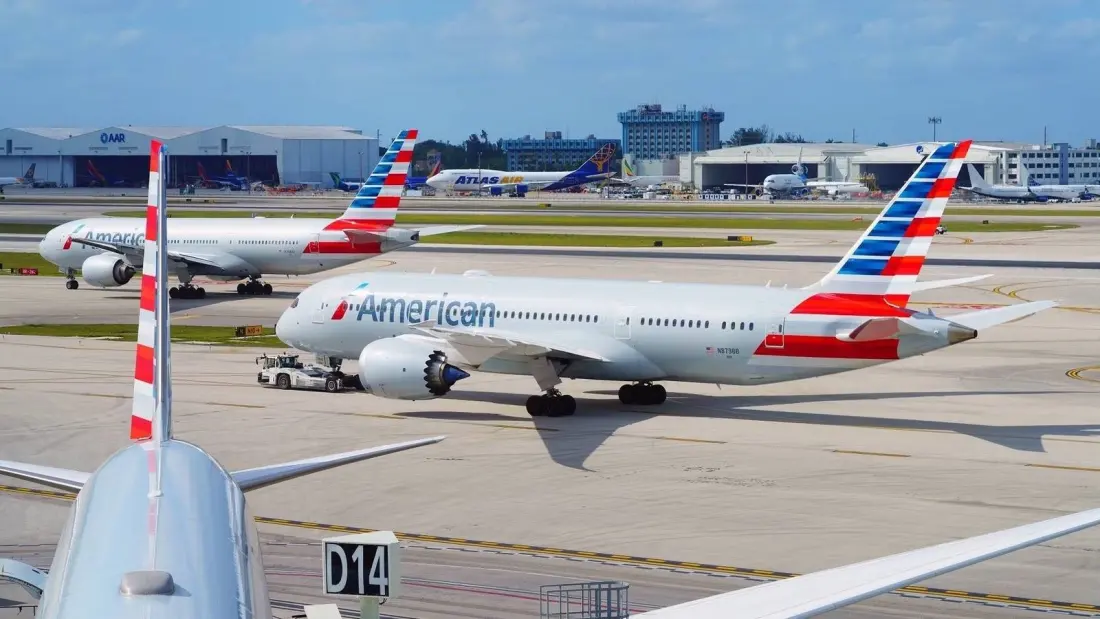
The break came in April 2018. American cancelled all 22 A350-900s and instead ordered 47 Boeing 787s (22 787-8s plus 25 larger 787-9s), with 28 options on top. The 787-8s arrived from 2020 and the -9s from 2023. The logic was fleet simplification: American simultaneously retired the Boeing 767-300, Airbus A330-300 and ageing 777-200ER, cutting the number of widebody types it operates. Fewer types means less pilot training, fewer spare parts, easier aircraft swaps, and a growing 787 subfleet where scale keeps costs down. Today American runs 37 787-8s and 33 787-9s alongside 67 Boeing 777s.
For travellers, what does this mean? The 787 fits American's transatlantic and transpacific networks well, and the airline avoided the risk and cost of introducing yet another new type. But there's a counterargument: the A350 is the most efficient large widebody flying today, and American lags Delta and United on premium cabin reputation and ultra-long-haul reach — areas where the A350 shines. A future order isn't impossible, especially if Boeing 777X certification delays (now stretching toward 2027) drag on, but the 777X remains the natural 777 replacement and American's Boeing relationship looks settled.
The takeaway for anyone watching airline fleets: aircraft choices are rarely about which plane is 'best'. American's call was about cash discipline, fleet commonality and matching capacity to its specific network — not a verdict on the A350 itself.