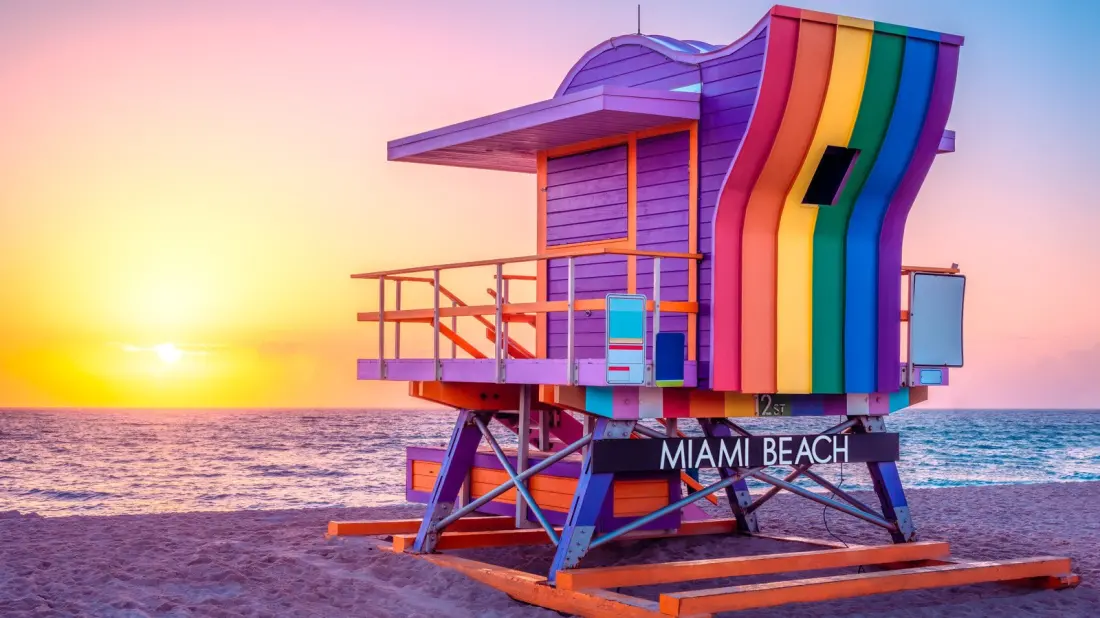
Miami Beach's lifeguard stands are hard to miss: bubblegum pink, sunny yellow, seafoam green and tangerine orange structures scattered along the sand from South Pointe Park all the way up to 86th Street. They look like oversized beach toys, but there's a real story behind them — and it starts with a hurricane.
On August 24, 1992, Hurricane Andrew tore through Miami-Dade County before dawn, flattening much of the beachfront, including most of the old lifeguard towers. Architect William Lane, who had recently moved to the area, saw the destruction as a design opportunity. He persuaded the city to let him rethink the towers entirely. His first five stands went up at Lummus Park in South Beach, their geometric curves and tropical colours slotting neatly into the neighbourhood's artsy character and becoming icons of the revitalising beachfront almost overnight.
About two decades later, when the original structures began aging, Lane and his team developed six new prototypes that now cover all 36 stands along the coast. Each tower stands roughly 8 feet above the sand within a footprint of just 260 square feet, built from timber and standing-seam aluminium — materials that bend easily into the abstract shapes and playful rooflines you see today.
For visitors, the stands are more than photogenic. They double as wayfinding beacons, which is handy whether you're meeting friends in spring break crowds or settling in for a sunrise. Locals have given many of them nicknames — "The Bed," "The Lighthouse," "Stars and Stripes," "Lisa Simpson" — but officially each stand is named after its nearest cross street. A rainbow-hued tower sits at the heart of 12th Street Gay Beach, while the teal-and-lime 30th Street stand looks straight out of the Mystery Machine. That one sits about a mile south of the Fontainebleau Hotel, whose bold modernist architecture helped inspire Lane's sculptural style.
The towers run all the way to Surfside, though swimmers heading north should know that North Beach is known for rip currents — one of several reasons to stay alert wherever you set up. The stands themselves have won design awards, and Lane has described them as expressions of identity and culture that turn the beach into something more dynamic than a stretch of sand.
If you're planning a Miami Beach trip, the towers make an easy, free sightseeing route: walk or jog the Boardwalk north from Lummus Park and you'll pass most of them, with Ocean Drive's Art Deco frontage on one side and the Atlantic on the other. Bring a camera in the early morning, when the light flatters the colours and the crowds haven't arrived yet.