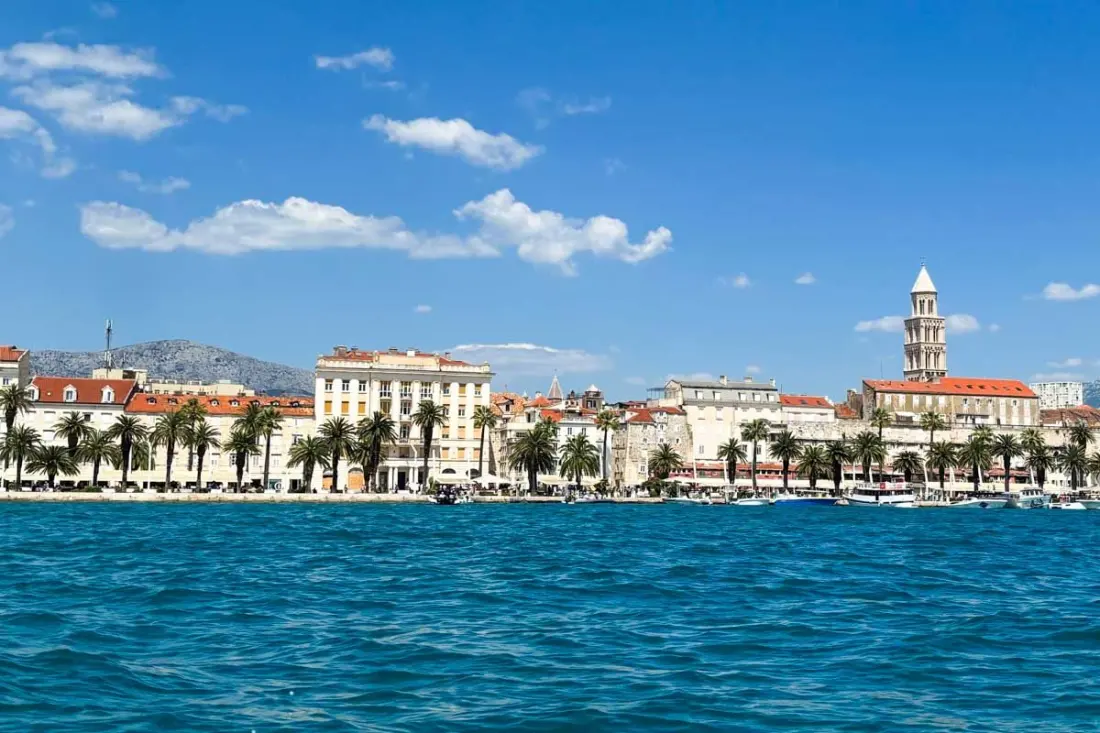
Few cities let you walk through a 1,700-year-old Roman palace in the morning and swim in the sea by lunchtime, but that is exactly the rhythm of Split, Croatia's Adriatic hotspot. The historic centre is compact, walkable and built around Diocletian's Palace, so the ancient stuff and the aperitivo hour overlap constantly. English is widely spoken, and the city doubles as a launchpad for Croatia's islands and waterfalls.
Start inside the palace walls, which are far more than ruins. The peristyle, the Golden Gate and St. Domnius Cathedral — originally built as the emperor's mausoleum — pack centuries of Roman, medieval and Venetian history into a tiny footprint. A guided walking tour is worth doing early in your trip, and climbing the cathedral's bell tower rewards you with panoramas over terracotta rooftops and the harbour. A combo ticket helps here: the Green Pass covering the cathedral, bell tower and Treasury costs €13, while the bell tower alone is €7.
For views without a real hike, Marjan Hill sits just west of the Old Town. The first terrace viewpoint is roughly 10-15 minutes of stairs from the Riva waterfront, and the restaurant Teraca Vidilica at the top makes a good excuse for a coffee or sunset drink. Go early or late in summer — midday heat makes those steps brutal.
Split's real magic may be the day trips. A full-day speedboat tour to the Blue Cave and Hvar (10-12 hours) takes in the impossibly blue water of the cave, the fishing village of Komiža on Vis, the cliff-ringed Stiniva Cove — a Mamma Mia! filming location — the Blue Lagoon, the Pakleni Islands and a couple of hours in Hvar Town. Closer to home, Krka National Park serves up Skradinski Buk's waterfalls via wooden boardwalks, a boat ride to Skradin with swimming, and often a wine tasting stop in Plastovo to round things off Dalmatian-style.
Back in town, food is its own attraction. Local specialities to hunt down include pašticada (rich braised beef), ćevapi (grilled sausages in flatbread), octopus salad and a glass — or caution — of almond rakija, which runs around 40% alcohol. An evening food tour around three hours is enough to cover the essentials and skip dinner afterwards.
A practical few things to know before you go. Stone streets get slippery when wet, stairs are everywhere, so pack grippy shoes — plus water shoes for the pebbly beaches. Sightsee the palace and Riva in the morning or evening in summer, when crowds and heat peak midday. And book early: accommodation inside the palace walls, ferries and popular tours sell out well ahead in peak season. A sensible three-day shape: one day for islands or Trogir, one for the palace, cathedral and food scene, and one for Krka's falls and wine.
Whether you're a history fan, a swimmer or a wine drinker, Split folds all three into a single afternoon — which is precisely why it keeps people coming back.
Story based on coverage from Destinationless Travel.