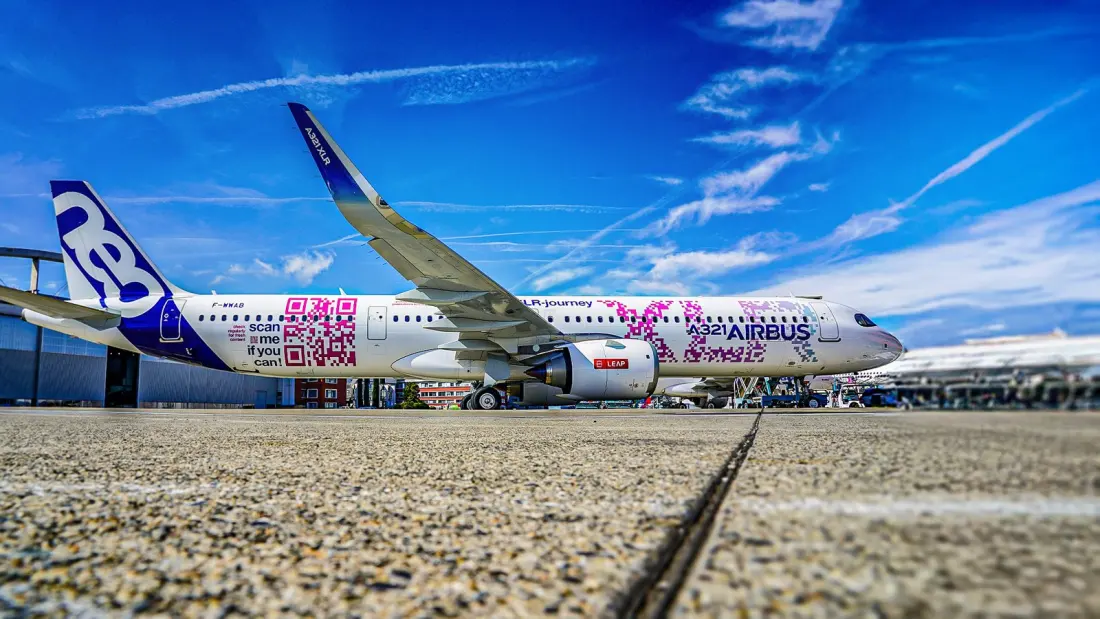
Airbus sells the A321XLR on a headline range of 4,700 nautical miles — the longest of any narrowbody in production. Yet look at what airlines actually schedule and most flights top out between 3,400 and 4,000 miles. The reason isn't a shortfall in the aircraft; it's a trade-off between how far a plane flies and how many people (and how much premium cabin) it carries.
The A321XLR gets its range from a permanent 3,408-gallon rear fuel tank and a strengthened frame that raises maximum takeoff weight to 101 tonnes. But that weight is a fixed budget. Fuel, passengers and cabin fittings all compete for it. An airline that stuffs 182 economy-heavy seats on board — like Air Canada, which swapped widebodies for the XLR on Montréal–Lyon in September — flies shorter sectors but moves more people at low unit cost. One that installs lie-flat suites flies lighter and farther, but with far fewer paying customers.
Iberia illustrates the middle ground: its 168-economy, 14-business layout delivers a realistic range of about 3,920 miles, which it uses on routes like Madrid–Boston and Madrid–Toronto. That still leaves nearly 800 miles below the brochure figure, much of it eaten by winter headwinds on the North Atlantic — westbound winds can exceed 100 knots — plus mandatory reserves for diversions and holding.
United went premium-first, fitting just 150 seats across three cabins, including 20 Polaris suites with doors. The heavy furnishings cost it roughly 32 seats versus a dense layout, but premium fares make thin routes like Newark–Luxembourg and Newark–Marseille viable. Notably, those aren't much longer than Iberia's flights; the heavy cabin, not the map, sets the ceiling. That's also why United leaves deeper Mediterranean points like Catania and Olbia to widebodies such as the 767.
The current distance leader is Iberia's Madrid–Santo Domingo at about 3,617 miles. That record falls in May, when American Airlines launches daily seasonal Philadelphia–Vienna service on 6 May — 3,755 miles, with westbound block times over 9.5 hours. American's 155-seat layout with Flagship Suites and a premium economy cabin keeps the weight down enough to make it work, though the schedule running from summer into early January means the return legs will battle peak winter jet stream.
One more constraint specific to this aircraft: the rear fuel tank occupies underfloor space that on a widebody would carry revenue cargo. The XLR has no belly-freight safety net, so the cabin alone has to pay for the flight. That's why the sweet spot for operators sits firmly in the 3,000–4,000 nautical mile band — long, thinner routes where the fuel-burn savings over a widebody offset the lost cargo. For travellers, the practical upshot is more nonstop options to secondary cities on both sides of the Atlantic, often with a genuinely premium long-haul seat at narrowbody fares.