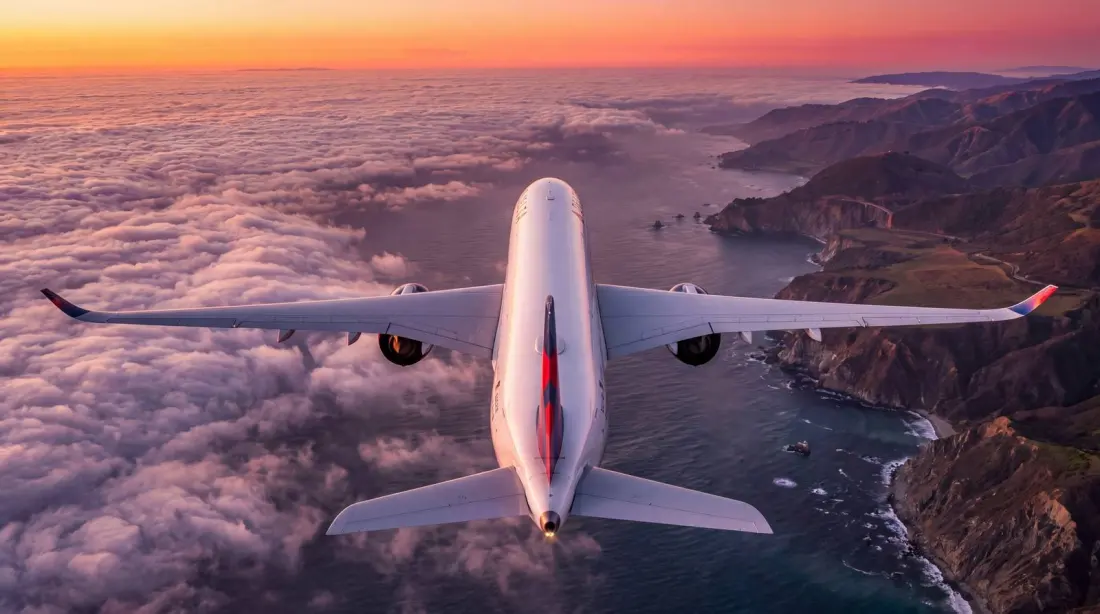
Delta has a five-year gap in its widebody plans, and one aircraft type is filling it. The airline's newly ordered Boeing 787-10s won't start arriving until 2031, so its 20 Airbus A350-1000s — the first of which enters service in early 2027 — will carry the full weight of Delta's Asia strategy until then.
That strategy is built around Seoul Incheon. Rather than funnelling travellers through Tokyo like most US competitors, Delta is formalising Incheon as its main Asian gateway, leaning on its joint venture with Korean Air. Passengers flying in from Atlanta or Detroit will connect seamlessly onto Korean Air's regional network, reaching secondary cities across East and Southeast Asia on a single ticket with aligned schedules, pricing and frequent flyer benefits. It's a setup aimed squarely at high-yield corporate traffic moving between North America and Asian financial centres.
The onboard product is where Delta hopes to win those passengers. The A350-1000 cabin is unusually premium-heavy: 53 Delta One Suites and 48 Premium Select seats give more than 40% of the floor space to premium travellers. The next-generation Delta One Suite gets a fully flat 1.98-metre bed and a 24-inch 4K QLED screen. Better still for anyone who's suffered dead zones over the Pacific, the fleet will be the first with multi-orbit connectivity — Hughes low-earth-orbit and geosynchronous technology integrated through Airbus HBCplus — promising genuinely uninterrupted high-speed internet on transoceanic flights.
The reason for all this concentration on one type is timing. Delta placed a record 95-aircraft order in the first half of 2026, off the back of a strong 2025 with $5 billion in pre-tax profit on $63.4 billion in operating revenue. But with the first eight A350-1000s only arriving through 2027 (later than originally planned) and the 787-10s five years out, planners have little slack. Expectations of new routes — Riyadh has been mentioned, though its launch has slipped — depend on later deliveries from 2028 onwards. Any supply chain wobble hits Delta's most important corridors first.
For travellers, the practical takeaway is straightforward: from early 2027, Delta's best long-haul product will appear on the Atlanta–Seoul and Detroit–Seoul routes first, and nowhere else for a while. If you're booking business or premium economy across the Pacific on Delta, that's where the new suites and fast wi-fi will be. The economics work in the airline's favour too — Rolls-Royce Trent XWB-97 engines deliver up to 20% lower fuel burn per seat-mile than the ageing 767s and 777s being retired. Whether one aircraft type can hold an entire transpacific strategy together until 2031 is Delta's problem, not yours — but it explains why the front cabin on those Seoul flights is about to get very good.