London Heathrow is legally capped at 480,000 aircraft movements a year, despite handling nearly 84 million passengers in 2024. Overnight, the squeeze gets tighter still: between 11:30 PM and 6:00 AM, airlines compete not just for runway space but for a limited noise quota. And that's where the Airbus A350 has quietly become the smartest widebody to fly.
Heathrow doesn't just count overnight movements — it grades them. Every aircraft type carries a Quota Count (QC) rating based on certified noise levels, from QC/0.125 for the quietest to QC/16 for the loudest. Aircraft rated QC/4 are effectively barred from the night quota period, and QC/8 and QC/16 types can't fly at night at all. So choosing a quiet aircraft isn't a green gesture; it's how airlines hang on to valuable late-evening departures and early-morning arrivals without burning through their noise allowance.
The A350 clears this bar thanks to two things working together. First, its Rolls-Royce Trent XWB engines — the only engine option on the type — are heavily acoustically optimised, with high-bypass architecture, acoustic liners and a refined fan. The A350-1000's engine makes nearly 97,000 pounds of thrust, yet the aircraft certifies at around 88.8 EPNdB on take-off. Airbus claims the type is up to nine decibels quieter than rivals, which — because decibels are logarithmic — means roughly 90% less physical noise. Second, the airframe itself: over 70% of the plane by weight is advanced materials, mostly carbon fibre, enabling the smooth, flexible 64.75-metre wing and clean aerodynamics that cut noise on approach as well as departure. Airbus says the A350's ground noise footprint is up to 50% smaller than comparable previous-generation aircraft.
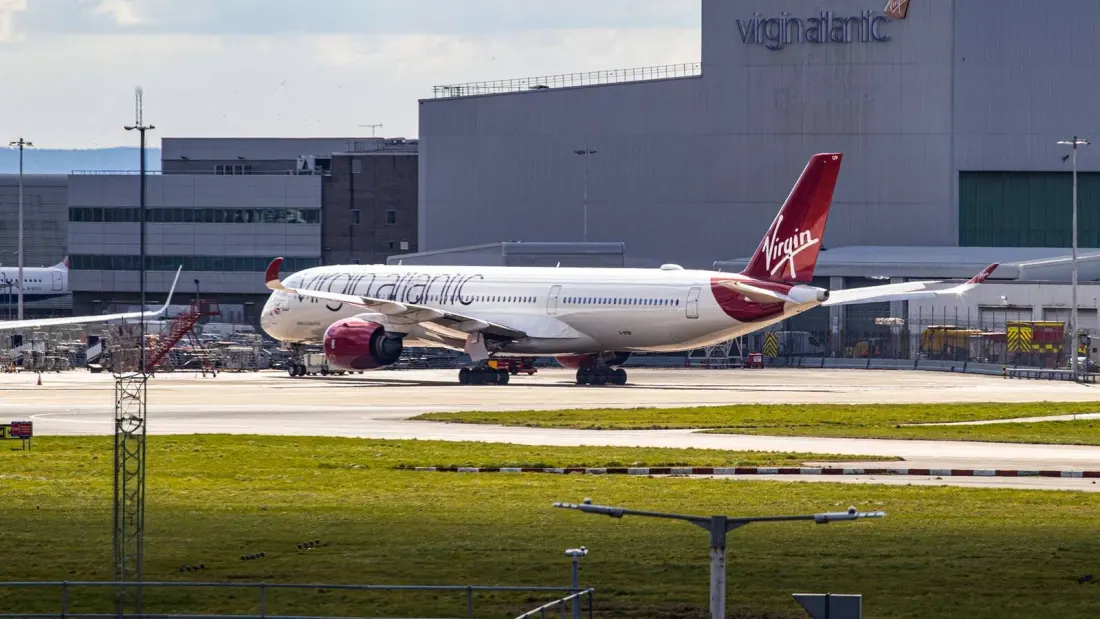
The commercial winners are clear. British Airways has built an 18-strong A350-1000 fleet and uses it on evening departures and early arrivals to New York, Washington, Dubai, Bengaluru and Lagos. Virgin Atlantic swapped its old A340-600s for A350-1000s, cutting fuel burn and emissions by about 30% while also dropping community noise. Cathay Pacific, Singapore Airlines, Qatar Airways, Japan Airlines and Finnair have all made the type a fixture on their Heathrow routes. Heathrow even rewards this through its Fly Quieter and Greener programme, which ranks airlines on noise performance, trackkeeping and continuous descent approaches.
For travellers, the payoff is direct. The same design that keeps neighbours happy makes the A350's cabin one of the quietest in the sky, with a cabin altitude near 5,500 feet instead of the usual 8,000, and humidity around double that of older widebodies. On a ten-hour-plus flight, that means less fatigue and less dehydration. So if your next long-haul booking lets you pick an aircraft type, choosing an A350-operated flight isn't just plane-nerdery — it genuinely changes how you'll feel when you land. Source: Simple Flying