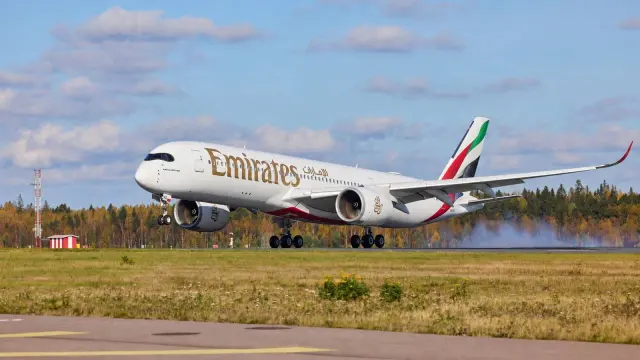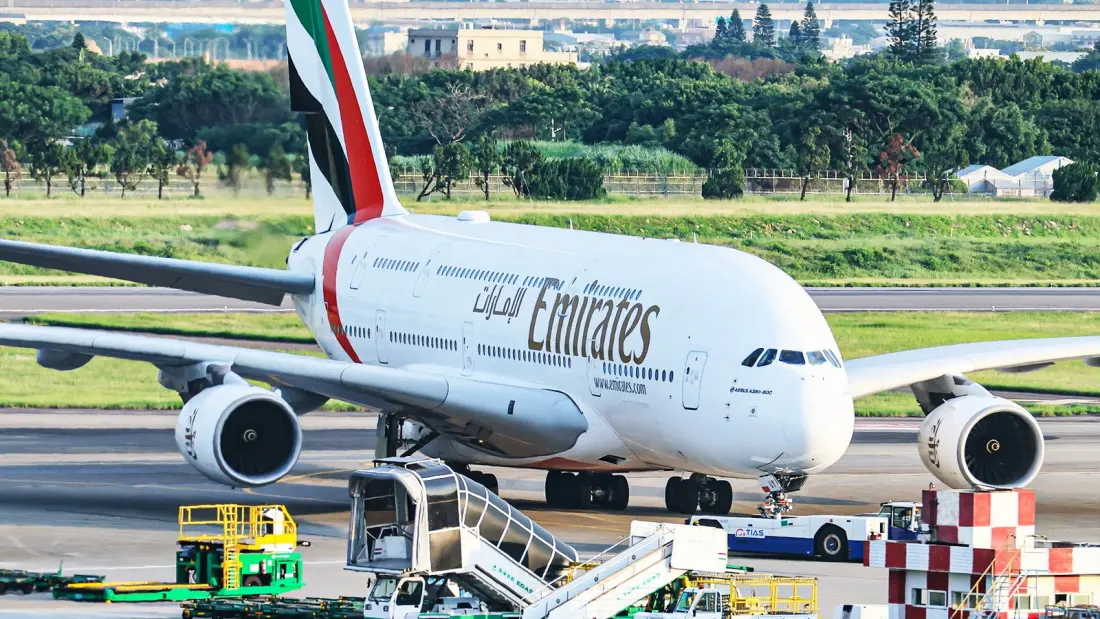
This autumn, the FAA ordered overhauls of the Engine Alliance GP7200 engines that power many Airbus A380s, after an uncontained turbine seal failure forced an aborted takeoff. Each engine sub-assembly replacement can cost up to $528,150 — a stark illustration of why running four giant turbofans is a headache most airlines no longer want. Yet while nearly every other operator has retired the superjumbo, Emirates is doubling down.
The Dubai carrier just posted a record $6.2 billion pre-tax profit for its financial year ending in March, and its leadership calls the A380 the most profitable aircraft in its fleet. Emirates has bought out 29 leased A380s outright, agreed to acquire six more from Qatar's Lesha Bank, and poured roughly $5 billion into cabin refits — showers, bars and premium economy decks — to keep the type flying into the 2040s.
The economics only work at scale. A380s burn around 4,600 gallons of fuel per hour, roughly 2.5 times an A350-1000's 1,823 gallons, and maintenance can exceed $6,000 per hour with total operating costs topping $30,000 per flight hour. But at slot-capped hubs like London Heathrow and New York-JFK, where Emirates can't simply add another daily flight, a single 85% full A380 carries nearly twice the high-fare passengers of a 787-9. The fuel penalty disappears. Small subfleets, by contrast, were a disaster — Air France's ten-aircraft operation, as Emirates president Tim Clark once put it, sent costs through the roof. Two high-profile incidents also haunted the type: Qantas Flight 32's Trent 900 explosion over Indonesia in 2010 and Air France Flight 66's GP7200 fan hub failure over Greenland in 2017.
The programme itself never broke even. Airbus absorbed more than $330 million in wing-rib crack repairs after a 2012 crisis tied to its pioneering carbon-composite centre wing box, and CEO Tom Enders shut the Toulouse line in 2019 after Emirates slashed 39 orders — the fallout of a bitter $9.2 billion engine switch from GP7200 to Rolls-Royce Trent 900 in 2015, complicated by Dubai's sand-accelerated fan blade wear. Clark still lobbies for an A380neo that would cut hourly fuel burn from 12 metric tons to 9, but Airbus wants about 250 commitments; Emirates offered 100.
For travellers, this all means one thing: the world's best-appointed aircraft isn't going anywhere if you're flying Emirates. Used A380s trade so cheaply that a single set of landing gear or four serviceable engines nearly matches the price of a whole airframe, so Dubai is cannibalising retired frames for spares and planning to fly the double-decker for another two decades. If you crave onboard showers and an upstairs cabin, book it while you can — no modern twinjet can offer that space. For the full engineering and economics deep-dive, the original reporting is worth a read.