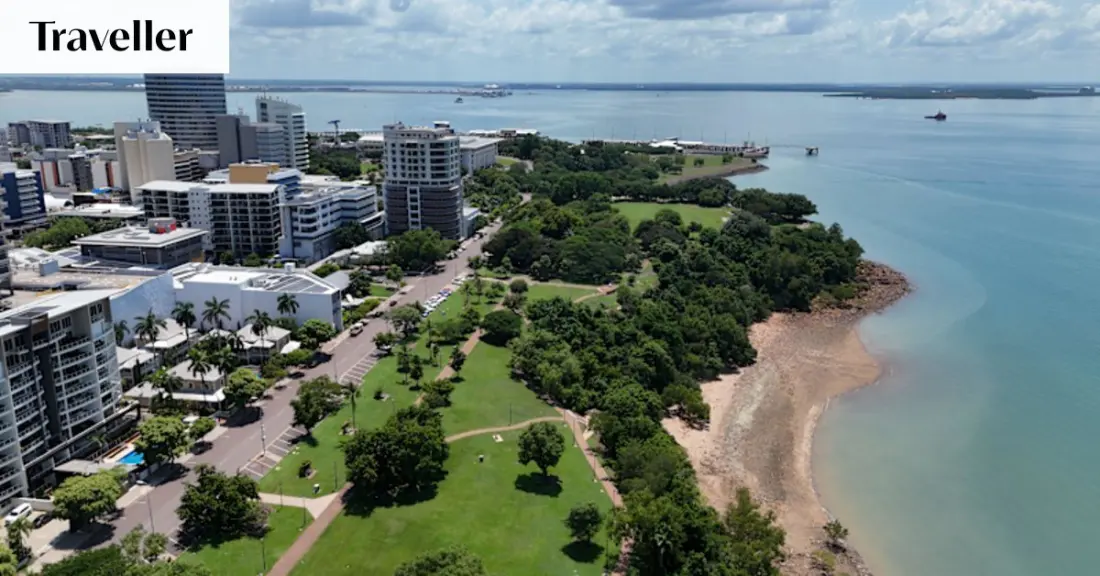
Darwin has no shortage of ways to spend a day: crocodile encounters at Crocosaurus Cove, sunset markets on Mindil Beach, galleries full of Indigenous art. But on a fourth visit to the city, one travel writer found the most powerful attraction is also the most low-key: Bicentennial Park, a long lawned strip between the city centre and the sea cliffs, where a series of signboards walks you through the Japanese bombing of Darwin on 19 February 1942.
The attack came barely ten weeks after Pearl Harbor, and the park's interpretive boards don't soften it. Darwin had been built up as a wartime base with a swollen population but negligible defences. Around 2,000 women and children had been evacuated, yet many civilians stayed, and 47 ships sat unprotected in the harbour when Japanese bombers arrived unannounced. The details are grim and human: anti-aircraft gunner Wilbert Hudson sprinting to his post wrapped in a towel as the first bombs fell; 21 wharf workers killed during a casual smoko; a telegraph supervisor who wired that bombs were 'falling like hailstones', then died with eight others when a makeshift trench near the postmaster's residence took a direct hit.
The boards run chronologically north-westwards along the park and lean on eyewitness accounts. A lieutenant aboard the destroyer USS Peary described burnt men climbing up airshafts from the forward fire room; an observer on HMAS Platypus watched Peary 'point her nose up to the sky' before vanishing in black smoke, guns firing to the end. Eleven ships were sunk, 30 aircraft destroyed and at least 235 people killed that morning. What makes these boards unusual is that they also question the political and military decisions that left Darwin so exposed — no sugarcoating, no virtual reality, just first-person words and a salvaged naval gun from Peary aimed at the spot where she sank. The Darwin Cenotaph marks where an anti-aircraft battery once stood.
None of this detracts from the park itself, which is one of Darwin's pleasantest spots: joggers on winding paths, picnickers under banyan trees, bougainvillea in lipstick pink above the emerald lawns, and the Arafura Sea — the route the bombers took — stretching pale blue beyond the cliffs. The storytelling style will feel familiar if you've seen the Cyclone Tracy exhibit at the Museum and Art Gallery of the Northern Territory, which covers the 1974 cyclone that wrecked the city again. Darwin, it turns out, is very good at telling hard stories through personal perspectives.
Why bother? Because it's free, takes an hour or two, and adds real depth to a city most travellers treat as a Top End launching pad. Pair it with the Bombing of Darwin exhibition, then carry on to Mindil Beach for the sunset market — you'll see the place differently.