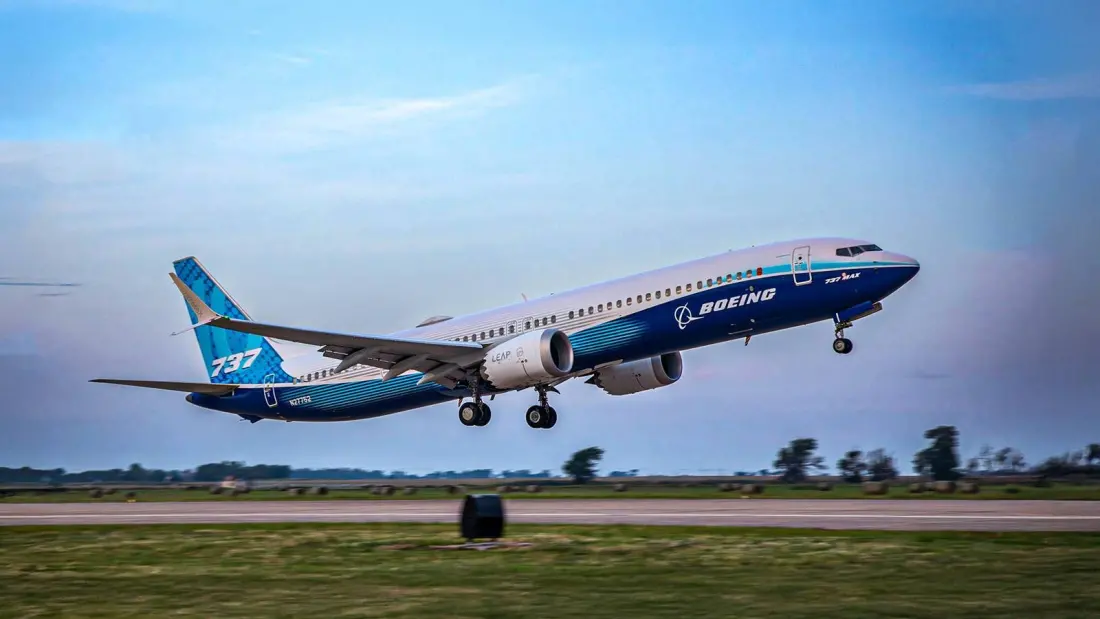
It sounds like a design flaw, but it's physics and certification rules working exactly as intended: the longest narrowbody Boeing has ever built can often touch down at an airport with a full cabin, then be legally unable to depart with the same number of people on board. The 737 MAX 10, which stretches the 1960s-era 737 design to carry up to 230 passengers, has a maximum takeoff weight of 197,898 lb (89,765 kg) — and that's where the trouble starts.
Landing is the easy part. By touchdown a jet has burned off thousands of pounds of fuel, and the MAX 10 needs only about 5,900 feet of runway to stop at its maximum landing weight. Takeoff is a different calculation. Regulations require the aircraft to survive an engine failure at V1 — the decision speed — meaning the runway must be long enough either to abort and brake from near 99 tons, or to climb away on one CFM LEAP-1B engine. At full weight that demands roughly 8,860 feet, a gap of nearly 3,000 feet over the landing distance.
Boeing also had a geometry problem. Stretching the fuselage by 66 inches compared to the MAX 9, with plugs ahead of and behind the wing, brought the tail dangerously close to the runway during rotation — a side effect of the 737's famously low-slung 1960s landing gear. Boeing's fix was clever: a semi-levered main landing gear that telescopes outward by about 9.5 inches as the nose lifts, moving the pivot point rearward and giving the MAX 10 the same tail clearance as the shorter MAX 9, all while folding back into the standard wheel well.
What the gear can't fix is aerodynamics. Unlike Airbus, which gave the competing A321neo and A321XLR a bigger wing, better flaps and engines producing over 33,000 lbf of thrust, Boeing kept the standard MAX wing and LEAP-1B engines at roughly 29,300 lbf per side. The result, according to industry analysts, is a weaker field-performance envelope. On hot afternoons or at high-altitude fields such as Denver, Albuquerque or Bogotá's El Dorado, thin air cuts lift and thrust, so dispatchers routinely trade payload for performance — offloading cargo, capping fuel, or blocking seats. Passengers still arrive fine; the aircraft just has to leave lighter.
For travellers, the practical upshot is that the MAX 10 shines on long, sea-level runways between major hubs — think Chicago O'Hare or London Heathrow — where its seat-mile economics make it a money-printer for airlines like United and Delta. But on shorter regional strips or hot-and-high departures, expect occasional weight restrictions, and on some transcontinental sectors even a fuel stop that a smaller MAX 8 wouldn't need. It's a niche high-density trunk liner, not an all-rounder — and knowing that explains a lot about why your flight plan looks the way it does.