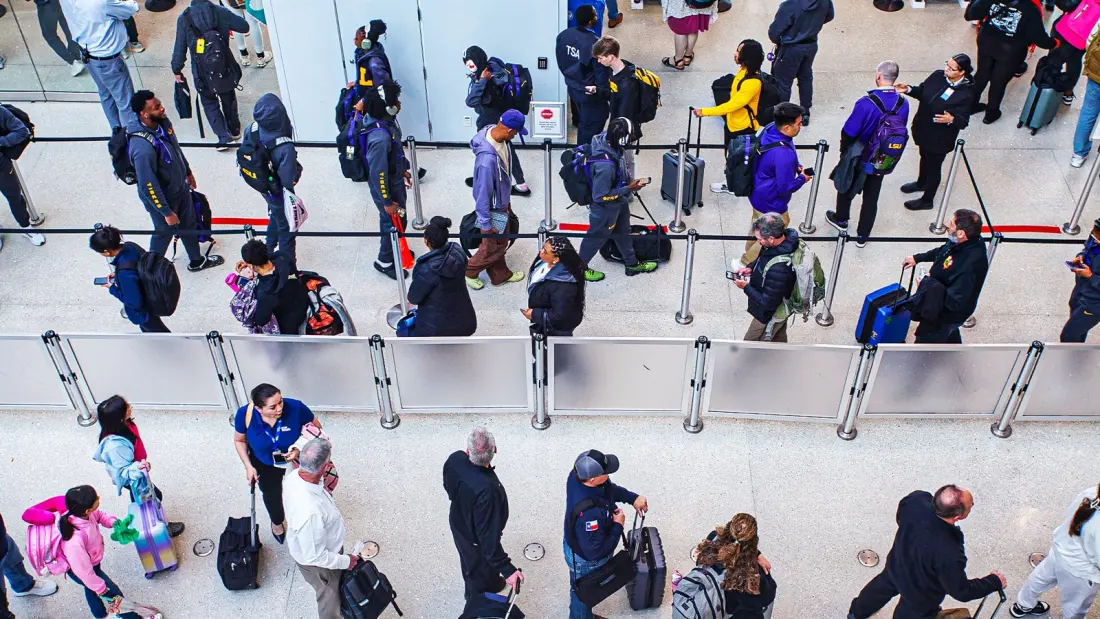
Rumours that America finally scrapped its 100ml liquids rule have swirled for over a year. They're wrong. At every US checkpoint today, the 3-1-1 rule still applies: liquids, aerosols and gels in containers of 3.4 ounces (100ml) or less, all fitting in one clear quart-sized bag.
The confusion traces back to July 2025. First, the Department of Homeland Security abruptly ended the long-standing shoe-removal requirement on July 8, which convinced many flyers that other post-9/11 hassles would fall too. Eight days later, then-Secretary Kristi Noem told a conference that raising container limits would be "the next big announcement". Headlines ran with visions of one-minute checkpoint sprints, but no timeline or detail ever followed. Former TSA Administrator John Pistole later confirmed the agency had quietly studied a rollback for years — it just hasn't happened.
The hold-up is hardware. The US only lifted its total liquids ban in favour of the 100ml limit back in September 2006, after UK intelligence foiled a plot to detonate explosives hidden in soda cans on transatlantic flights. Ditching the rule now depends on Computed Tomography (CT) scanners, which build 3D images of bags and can automatically flag hazardous liquids — meaning laptops and toiletries can stay packed. As of July 2026, the TSA had 1,162 CT units across 296 of the country's 430 federalized airports, leaving hundreds of smaller regional checkpoints on legacy 2D X-ray machines. The agency's new 'Horizon 25' strategy, launched August 24, 2026, targets full deployment — but current DHS projections push that to fiscal year 2034, with around $192 million per year earmarked for screening systems. The machines are huge, too: many older terminals lack the floor space or load capacity for them without remodelling.
Meanwhile, the UK has largely moved on. Heathrow finished a £1 billion overhaul in January 2026, replacing every lane across its four terminals and scrapping the 100ml limit entirely. Gatwick, Edinburgh, Birmingham, Bristol and Belfast now allow liquids up to two litres, though Manchester, Stansted and Luton missed deadlines and still enforce the old rule. The EU is taking an airport-by-airport approach with certified C3 scanners.
That patchwork creates what analysts call the 'Return-Flight Trap': rules follow your departure airport, not your airline or passport. Fly out of Heathrow with a two-litre bottle of sunscreen and you'll have it confiscated on the way home through a US checkpoint — or even Manchester.
The practical takeaway: pack as if the 100ml rule applies everywhere, because at most US airports it does. At CT-equipped lanes you can usually leave liquids and laptops in your bag, but oversize carry-ons may be diverted to secondary screening, and procedures vary even within a single terminal. Full relief for US flyers is coming — just not this year, and possibly not this decade.