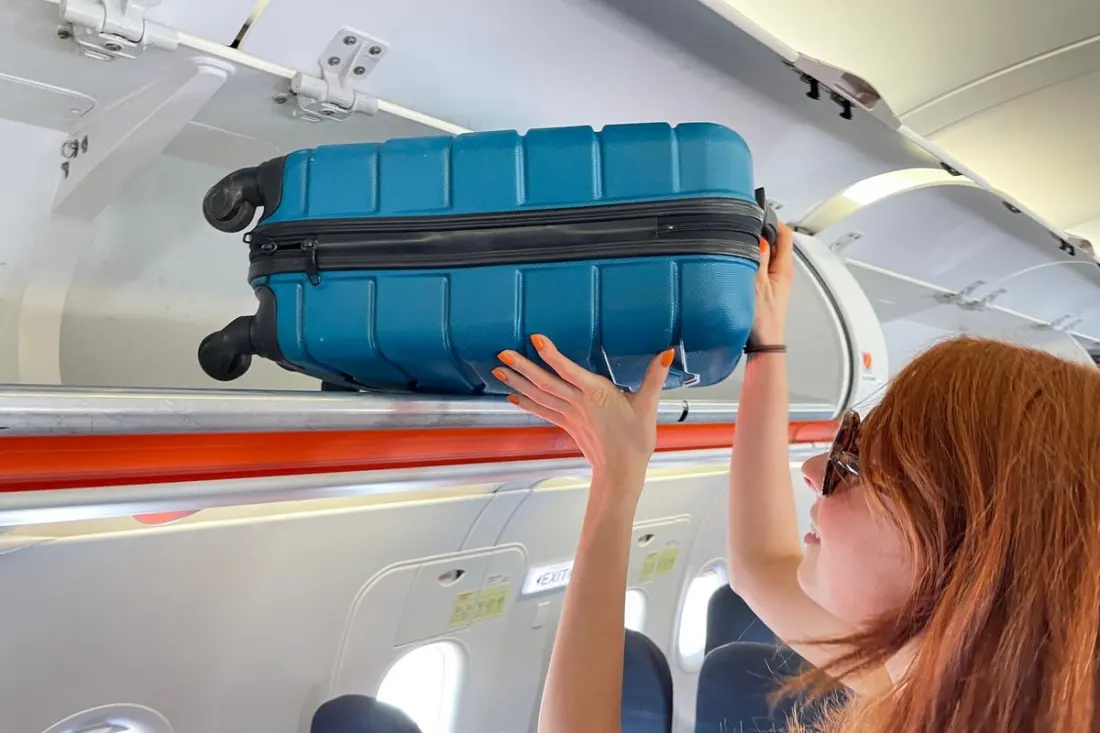
Ever boarded last, only to find the overhead lockers are already crammed full? You're not imagining it, and a former pilot turned aviation safety researcher says the growing pile of cabin baggage is a genuine safety problem – one that explains why airlines keep tightening their carry-on rules.
The rules are shifting fast, too. From 2 February 2026, Virgin Australia will let economy passengers on domestic flights bring just one standard cabin bag of up to 8kg for the locker, plus a small under-seat item. Air Canada recently restricted basic-fare passengers on North and Central American routes to a single personal article. Even on identical aircraft, limits vary wildly: fly Qantas within Australia and you can take one 10kg bag plus a personal item, or two pieces totalling 14kg. Jetstar allows only 7kg across two items. Same Boeing 737, completely different rules.
So where do these numbers come from? Physics, mostly. Every aircraft has a maximum take-off weight covering the plane itself, fuel, catering, cargo, crew and everyone's bags. Checked bags get weighed at the desk, but carry-on is estimated. On small aircraft – say, under seven seats in remote parts of Australia – passengers literally step on scales with their bags. On bigger planes, regulators use standard average weights: in Australia an adult man is now assumed to weigh 81.8kg and a woman 66.7kg, with 7kg of carry-on per passenger assumed on top. The twist is that airlines can apply to the regulator, the Civil Aviation Safety Authority, to use their own figures – which is why rules differ between carriers on the same route.
Money explains the rest. Carry-on limits used to be fairly standard until low-cost carriers started monetising everything beyond the ticket: bags, food, Wi-Fi. The industry group IATA forecasts ancillary revenue will hit US$144 billion this year – more than the entire global air cargo business. Airlines know passengers try to dodge checked-bag fees by hauling everything onboard, so they now charge for exceeding carry-on limits too. The bag fees never really went away; they just moved to the gate.
There's a human cost as well. Cabin crew regularly suffer back and lifting injuries wrestling heavy bags into lockers, and boarding delays mount when everyone's fighting for bin space. More seriously, in an emergency evacuation, passengers who stop to grab their bags slow everyone down – a behaviour repeatedly shown to cost precious seconds.
The takeaway for travellers is simple. Check your specific airline and fare's carry-on allowance before you fly, because the same plane can mean an 8kg limit on one carrier and 14kg on another. Weigh your bag at home; gate fees sting far more than checked-bag fees booked in advance. And pack lighter than the maximum – you'll board faster, spare the crew's backs, and if the worst ever happens, you'll be doing your part to get everyone off the plane quickly.
Full story via The Independent Travel.