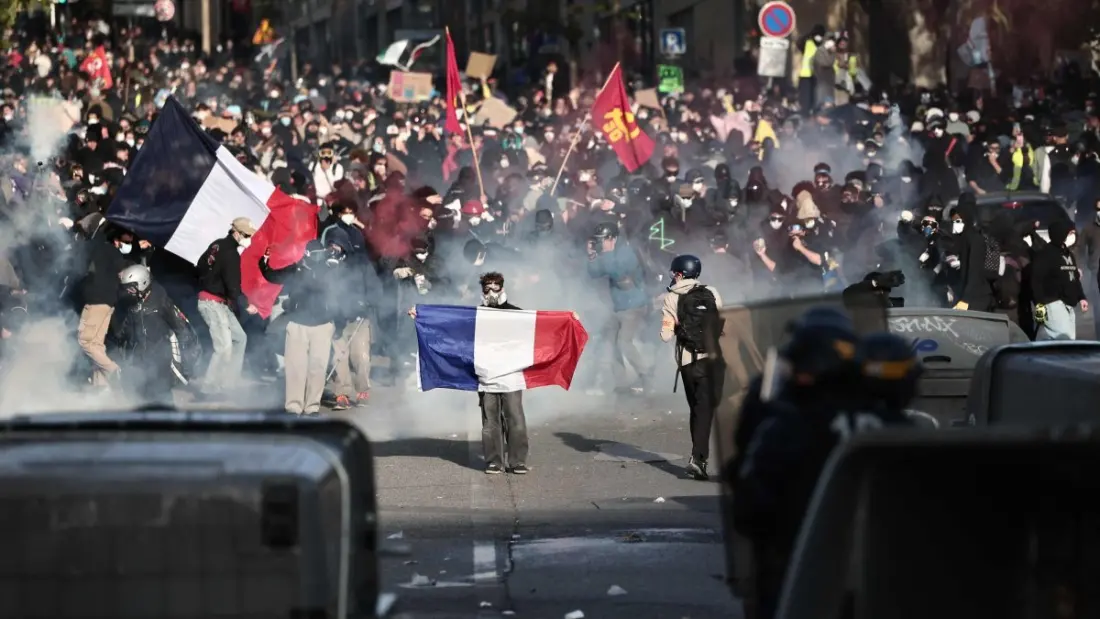
France saw another weekend of disruption as more than 400,000 people marched in 289 separate protests across the country, according to the Interior Ministry, over school funding cuts and the rising cost of living. The Paris march alone drew an estimated 110,000 people (union organisers claimed far more), and it stayed peaceful until its endpoint in the city's southeast, where masked protesters clashed with police and tear gas filled the air. Nearly 1,000 arrests were reported nationwide.
For anyone travelling to France right now, the practical effects are real. Major museums including the Louvre closed for the day in Paris, shopkeepers boarded up storefronts across the capital, and the Art Basel fair cancelled its entire weekend programme after opening for just one day. Rallies were banned outright in Lyon, Nice and Montpellier — bans that unions called unconstitutional — and in Nice, far-right extremists brawled with demonstrators downtown, leading to 11 arrests. Street fires burned in Marseille and Lyon, and police deployed tear gas in Strasbourg, Clermont-Ferrand and Bordeaux, with water cannons used in Nice and Nantes.
The movement began about a month ago with a single high school protest southeast of Paris over staff shortages, then snowballed into a national challenge to President Emmanuel Macron in his final months in office before May's election. Students are demanding 250,000 more university places, an overhaul of the Parcoursup admissions system, more teachers and school repairs, plus cost-of-living help: an extra €200 a month in grants and a rent freeze in public student housing. Workers have joined over soaring prices — energy costs were up 21.3% year-on-year in September, pushing overall inflation to 3.1%.
The political backdrop adds another layer of unpredictability. The far-right National Rally, holding its congress in Orléans the same weekend, is pitching itself as the answer to public anger, while the left backs the demonstrators and criticises policing that has injured teenage protesters.
Interior Minister Laurent Nunez credited a huge deployment — 70,000 officers, helicopters and armoured vehicles — with preventing a repeat of the previous weekend's widespread looting. Still, turnout dipped from 550,000 the week before, and organisers show no sign of standing down.
If you have a trip to France planned in the coming weeks, build in some flexibility. Check whether museums and attractions are open on the day, expect possible transport disruption and road closures in big cities, and steer clear of large gatherings — clashes have flared at the tail end of otherwise peaceful marches. Weekend city breaks to Paris, Lyon, Marseille and Nice are the most likely to be affected.