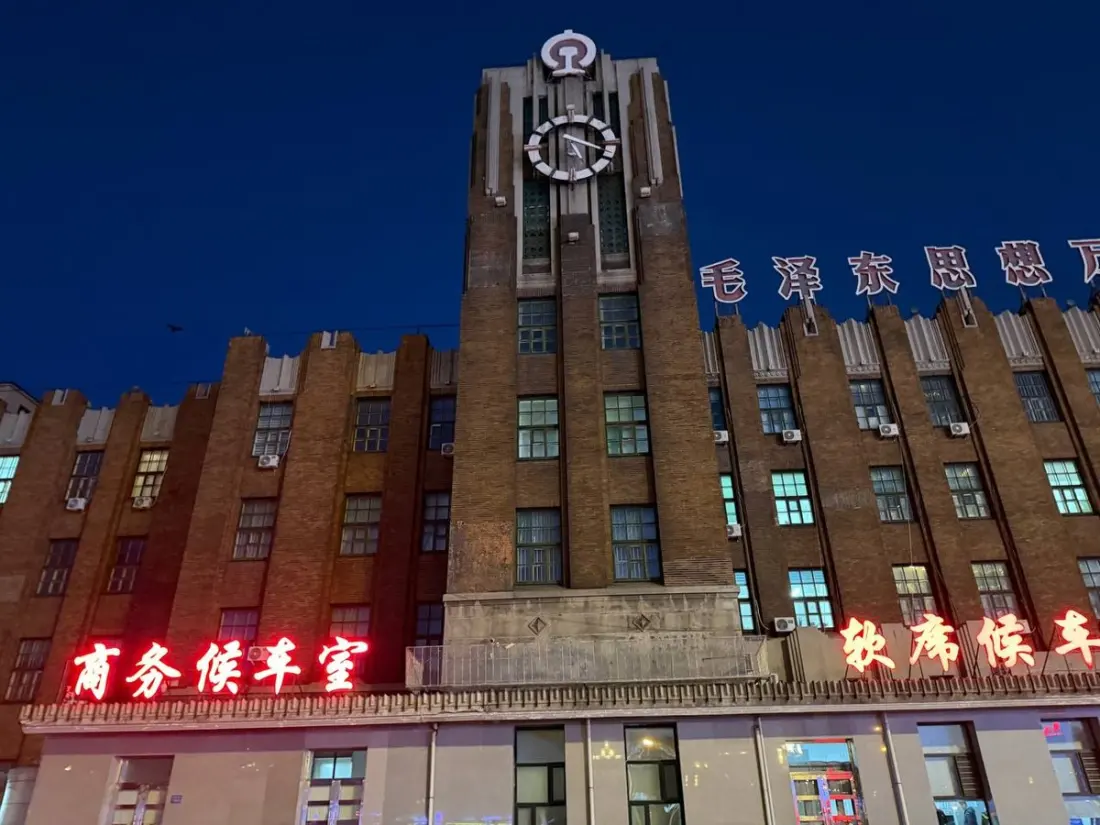
In China's far north-east, a 1930s Japanese-built station sits quietly beside its gleaming modern replacement, topped with two rooftop slogans from another era: "Long Live the Communist Party of China" and "Long Live Mao Zedong Thought". Neither is lit up at night — unlike the illuminated new station next door — which, as one recent visitor noted, makes the old building look deliberately downplayed.
The old Qiqihar Railway Station was completed in 1936, during the Japanese occupation of Manchuria and the puppet state of Manchukuo. Its heavy facade and institutional styling are classic Japanese railway architecture of the period, when trains moved troops and resources across the occupied north-east. Puyi — the last Qing emperor, installed by the Japanese as Manchukuo's figurehead ruler — appears in the building's ceremonial history too. After 1945 the station carried on under Chinese administration, gained its Maoist rooftop slogans during the Communist era, and lost its main passenger role when a replacement terminal opened in 1979. Today it houses railway administration offices.
The visit itself is short and sweet. Half an hour is plenty to take in the building and its slogans, and it's an easy add-on if you're arriving or departing by train, since old and new stations sit side by side (Qiqihar also has a third option, the high-speed Qiqihar South). Come at dusk if you want the contrast between the darkened slogans and the lit-up modern terminal — though daylight will show the architecture off better.
Qiqihar itself is well off the tourist trail. It was once a military and administrative centre, then a heavy-industry hub producing machinery and railway equipment, and like much of the north-east it has struggled through economic restructuring and population decline. That leaves a cityscape of abandoned factories and faded neighbourhoods — gritty rather than polished, but genuinely interesting if you're drawn to post-industrial China, Communist history or the Manchukuo period. There's also a large steel statue of Chairman Mao in town, another leftover the younger, faster China has moved on from.
Rail-wise, the city punches above its weight. Conventional trains reach Harbin in three to three-and-a-half hours (hard seat from around RMB 40), while the classic slow service to Beijing takes a proper 20 to 29 hours — hard sleeper roughly RMB 305–377 if you fancy the long haul. Dalian, the Russian border city of Manzhouli, and even Mohe in China's far north are all reachable by conventional rail. Prefer speed? Qiqihar South's high-speed trains do Harbin in under two hours (about RMB 149 second class), Beijing in six to seven-and-a-half hours (around RMB 778), and Dalian in about six hours.
Who is this for? Not the first-time China traveller chasing the greatest hits. It's for railway enthusiasts, history buffs with a Manchukuo-era itch, and independent travellers who like their destinations rough-edged and lightly touristed. Young Pioneer Tours doesn't currently run group trips here — this came from a research visit — but the city can be folded into an independent China itinerary, and it's arguably one of the better-connected bases for exploring the country's industrial north-east.