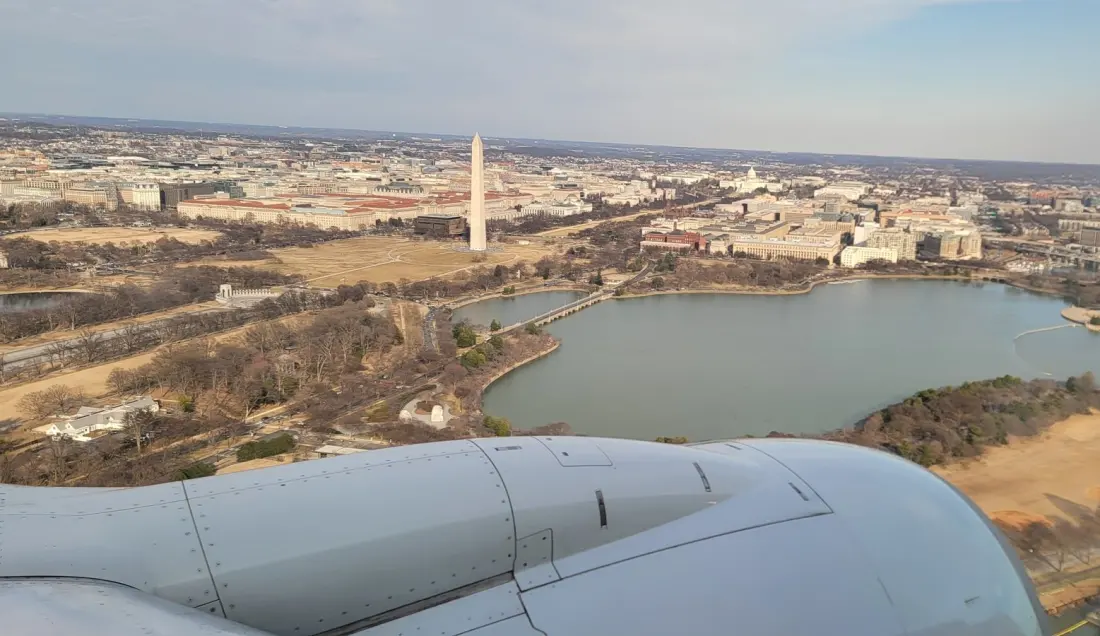
A short hop that used to be scheduled at just over an hour now shows 1 hour 42 minutes in the timetable — even though the actual airborne time hasn't changed. That observation from former Ohio Attorney General Dave Yost, complaining about his flight to Washington's Reagan National Airport, kicked off a familiar argument: airlines pad their schedules to look punctual. The reality is more interesting, and more expensive for the airlines themselves.
The published duration is what's called block time — gate to gate, not wheels up to wheels down. That includes taxiing, queuing for a runway, and finding your gate at the other end. Reagan National is a case study in why that matters: after the fatal collision in January 2025, the FAA cut the airport's hourly arrival rate from 36 flights to 26, later raising it only to 30. Controller shortages, equipment problems and concentrated demand at peak times all stretch the trip. And it's not just average delays that matter — it's unpredictability. An airline has to build a schedule that works on a bad-but-normal day, not just when everything runs perfectly.
Here's the part that punctures the conspiracy theory: padding is costly. Scheduled time can drive crew pay — American's flight attendants are paid on the greater of scheduled or actual block time. Extra minutes across a day of flying reduce aircraft productivity, potentially forcing an airline to add planes and crews just to run the same service. Southwest once estimated that a couple of added minutes across its whole schedule would cost the equivalent of 8 to 10 aircraft per day. Longer trips are also harder to sell against faster competitors or simply driving.
That said, longer schedules can genuinely improve reliability, not just statistics. A flight counts as on time if it reaches the gate within 15 minutes of schedule, so realistic block times give a buffer that helps passengers actually make connections. American lengthened its schedules as part of a rework of its Dallas hub, shifting from nine big connecting waves to thirteen smaller ones — and reported missed connections down 50% by April. United has used early arrivals built into schedules to hold departures for connecting passengers without officially running late.
There's a catch on arrival too: landing early doesn't guarantee a free gate. If the assigned gate is still occupied, or the staff to operate the jetbridge aren't there, you can sit on the tarmac and reach the terminal right around the originally scheduled time anyway.
For travellers, the takeaway is practical. Check the block time, not just flight time, when comparing connections — a tight 45-minute connection may be tighter than it looks once taxi and gate waits are factored in. And if your flight consistently lands early but you disembark on schedule, congestion at the gate, not the airline's clock games, is often the reason. The real fix, as the source argues, is more airport and air traffic control capacity — not shorter timetables.