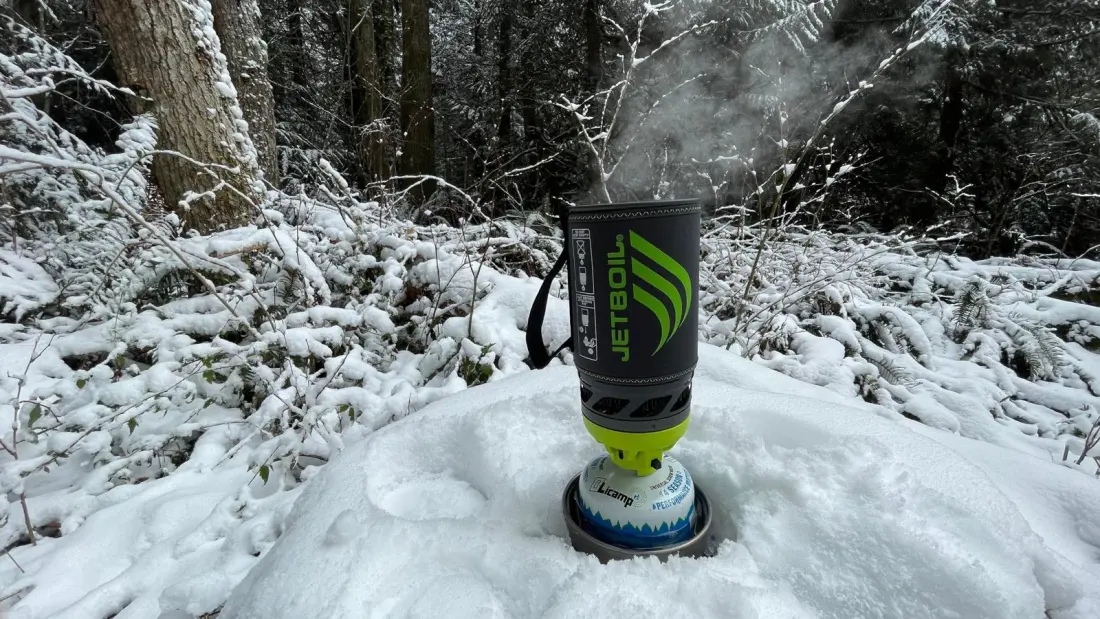
Backpacker's gear editors have a seasonal warning for anyone planning cold-weather camping trips: the trick to a decent flame from a canister stove in winter is gentle warming — and doing it wrong can genuinely be dangerous.
Anyone who has tried to boil water for dinner on a freezing evening knows the problem. Isobutane canister stoves, the lightweight choice for most summer backpackers, lose pressure as temperatures drop. The result is a sputtering, feeble flame and a long wait for soup. Serious winter campers often just switch to liquid fuel stoves like the MSR Whisperlite, which handle sub-freezing conditions well, or buy a canister stove with a built-in pressure regulator. But if you'd rather not own a whole shelf of stoves, warming the canister itself keeps the internal pressure up enough to cook all year round.
Here's where the caution comes in. Canister fuel is pressurised, and most manufacturers warn against letting a canister exceed roughly 120°F. Rapid heating methods — the classic mistake is dunking a canister in boiling water — can over-pressurise it to the point of explosion. Backpacker recounts one unfortunate soul who punched a hole in his ceiling attempting a canister-to-canister fuel transfer with heat involved.
A popular hack circulating on Reddit involves strapping a chemical hand warmer to the canister and wrapping the whole thing in an insulated pouch. The experts Backpacker consulted aren't fans. Adam Wilcox, senior mechanical design engineer at Jetboil, points out that you're adding a continuous, uncontrolled heat source and insulating it at the same time — with no reliable way to monitor the canister's temperature. Hand warmer maker Hothands says its products average 135°F and can top 158°F at maximum, so even if the fuel doesn't reach those temperatures directly, the method stacks the risk the wrong way.
The safer options are boring but effective. Tucking the canister inside your jacket for a few minutes before cooking adds enough pressure for a quick boil, though the benefit fades fast once the canister sits in cold air. For longer cooking or snow-melting, Wilcox recommends a warm-water bath: sit the canister in a dish or spare pot (a collapsible silicone bowl works well), light the stove, and pour warm — not hot, and definitely not boiling — water around the canister just as it starts to heat. Performance improves almost immediately.
If you're shopping rather than improvising, a regulated stove solves the problem at the source. MSR says its Pocket Rocket Deluxe can run at full power at just 16.5 PSI of canister pressure, when a full canister at room temperature sits around 45 PSI — meaning it keeps going long after an unregulated stove would fade.
For winter hikers, snow campers and anyone eyeing a shoulder-season trip, this is the difference between hot food and a frustrating evening — or worse. Gentle heat, patience, and possibly one stove upgrade are all it takes.