
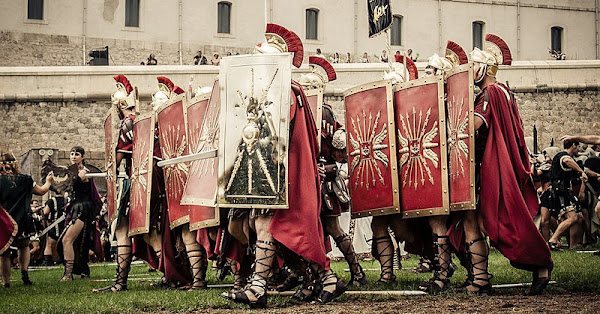
On the edge of the Gobi desert in Gansu Province sits Zhelaizhai, a quiet village with a claim to fame that sounds like fiction: locals say they are the descendants of Roman soldiers who somehow marched across Central Asia and settled in Han Dynasty China. Historians largely dismiss the idea, but the legend has stuck, and it still draws curious travellers to this far corner of north-west China.
The theory was built by Oxford sinologist Homer H. Dubs in the 1940s and 50s. He stitched together a chain of ancient events. In 53 BC, Marcus Licinius Crassus invaded the Parthian Empire and was crushed at the Battle of Carrhae, near modern-day Turkey and Syria. Thousands of his legionaries were captured and reportedly shipped east to defend Parthia's frontier. Then, in 36 BC, Han Chinese forces fought the Xiongnu leader Zhizhi in Central Asia. Chinese chronicles describe enemy troops using a "fish-scale" formation — shields locked closely together — which some read as the Roman testudo, a tactic otherwise unknown outside Rome. Roughly 145 prisoners were taken, and Dubs argued they were Carrhae survivors resettled as border colonists in China, a century before Rome and Han China had any recorded contact.
Zhelaizhai became the poster child for the story. Archaeologists found old walls, a Roman-style pot, a water bowl, and a helmet inscribed with the Chinese characters for "one of the surrendered." The village's ancient name, Liqian, was sometimes used in Han texts for the far western lands associated with Rome. And some residents have light eyes, curly hair, and paler skin than their neighbours — traits long cited as proof of European blood.
The evidence, though, has not survived scrutiny. Han records suggest Liqian existed at least two dozen years before any Roman prisoners could have arrived. A 2008 DNA study by Lanzhou University tested 87 villagers and found paternal lineages overwhelmingly East Asian, closely matching surrounding populations; only three showed any West Asian traits, and not the Mediterranean kind. Historians also point out that Gansu has been a crossroads for millennia — Silk Road traders, Sogdians, Tocharians, Turks, and other peoples with western Eurasian features passed through long before and after Rome. Even the fish-scale formation has a mundane explanation: Chinese texts describe a tight formation, not necessarily a Roman tactic.
None of this has dented local pride. Zhelaizhai still embraces its legionary heritage, and that mix of myth, archaeology, and identity is exactly what makes a visit rewarding. For travellers exploring the Silk Road corridor of Gansu — perhaps en route to Jiayuguan's fortress or the Buddhist caves at Dunhuang — the village offers a genuinely odd detour: a place where the legend of two ancient superpowers colliding lives on, whatever the DNA says.
Who is this for? Anyone road-tripping the Hexi Corridor with a taste for weird history, or travellers who enjoy destinations with a good story even when scholars disagree. Just go for the legend, not the proof.