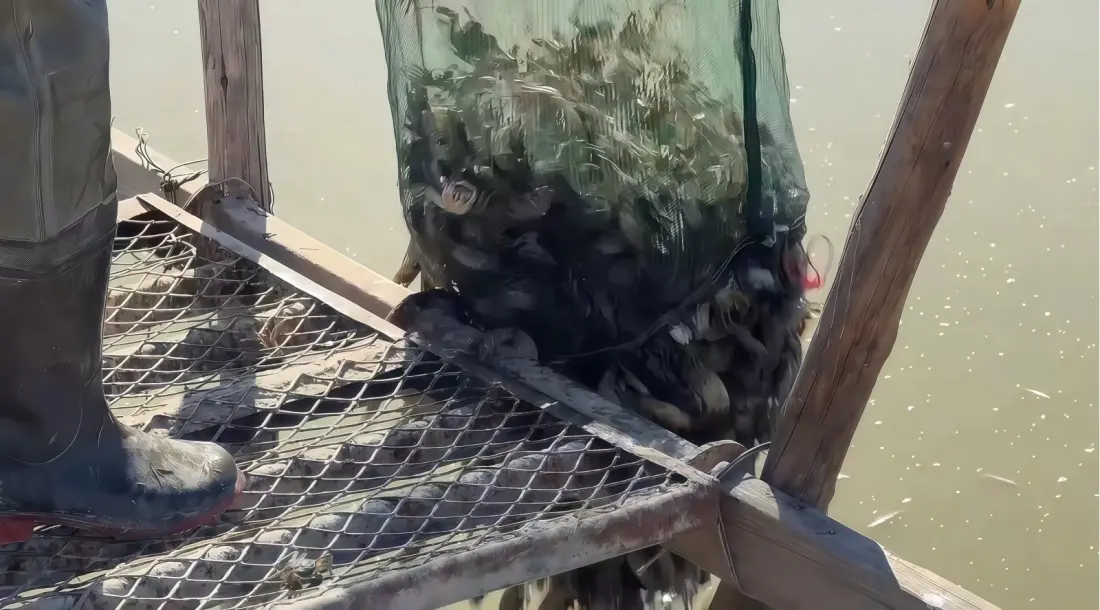
Winter has settled over the Yellow River's 'Ji-shaped bend' in Juungar Banner, Ordos, Inner Mongolia — and beneath the surface of purpose-built ponds, some 20,000 jin (roughly 10 metric tons) of young seed crabs are settling in for the cold months. Raised at the Yellow River Rice-Fish Eco-Tourism Park, they were lifted from their rearing cages in recent weeks and moved into overwintering ponds, where they'll wait until May before returning to the rice paddies to grow to market size by autumn.
The story behind those crabs is a striking one. Around Xiaotanzi Village in Dalu Town, about 80 percent of the land is chronically saline-alkali — soil so salty it once looked, as locals put it, like a stretch of white where nine crops in ten failed. Corn yields hovered below 300 jin per mu (about 2.25 tons per hectare), and soil erosion had at one point degraded more than 70 percent of the banner's land. The Yellow River runs 238 kilometres through Juungar Banner, and this stretch was long one of its major sources of coarse sediment.
The turnaround began in 2018, when Dalu Town paired saline-alkali soil improvement with integrated rice-fish farming. Ditches flushed salts from the ground, organic fertilizer rebuilt the soil, and salt-tolerant rice went in on a trial basis. By 2022 the park had scaled up to a full 'rice, crab and fish' polyculture: the crops shade the aquatic animals, and their waste fertilizes the fields — three harvests from a single plot.
This year's crab cycle started in May, when the park brought in 200 jin of megalopae (post-larval crabs) from Panjin in Liaoning province and released them into the paddies. Raising seed crabs in-house, now in its third year, has cut stock costs and improved survival rates, says Qiao Sheng, who heads agricultural production at the park. Of the 20,000-plus jin produced, half will restock the park's own rice fields; the other half will be sold. Survival through the past two winters has held steady, and the village's collective income passed 500,000 yuan in 2025, with per-capita income reaching 30,000 yuan.
For travellers, this is Inner Mongolia well beyond the grasslands postcard: a working example of how a battered river landscape has been coaxed back to life, with an eco-tourism park at its centre. If you find yourself in the Ordos region — perhaps combining a trip with the Ordos grasslands, the Kubuqi Desert or the Genghis Khan Mausoleum further afield — the rice-crab country around Dalu Town offers a look at China's rural ecological restoration in action, plus the promise of fresh river crab when autumn harvest season comes round. Just time it right: the fields are quiet in winter, and the crabs you'd see then are literally hibernating.