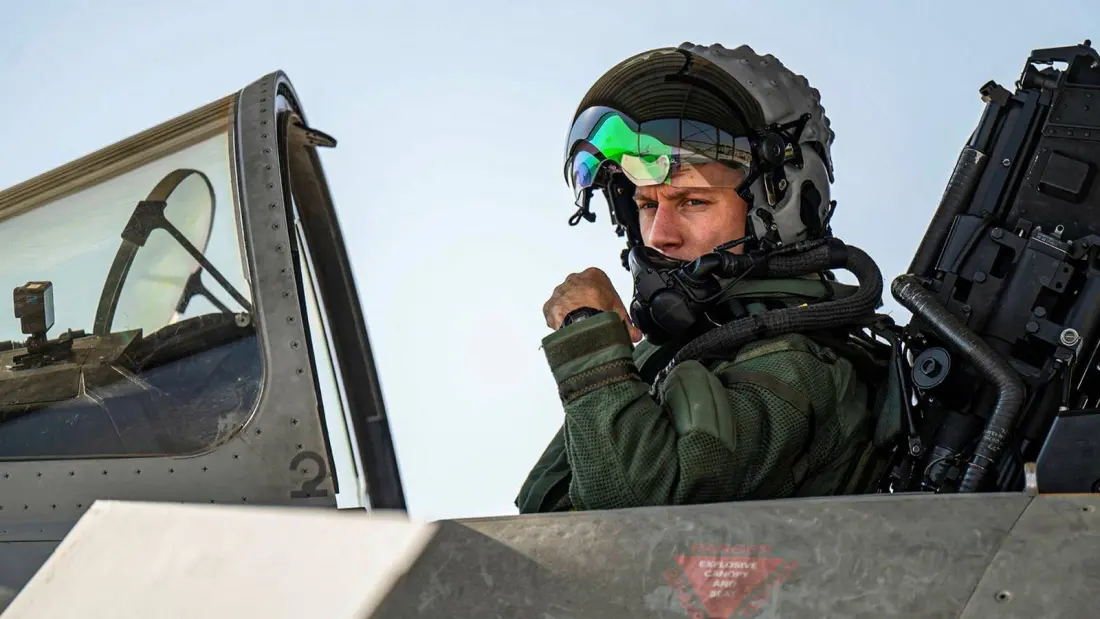
A bomber crew can swap seats and sleep in shifts. A single-seat F-35 pilot flying a marathon patrol over the Pacific cannot — no co-pilot, no cot, just an ejection seat and a parachute for a headrest. As the US Air Force pushes fighter squadrons across vast stretches of the Indo-Pacific under its Agile Combat Employment (ACE) doctrine, sorties that once lasted two or three hours are now stretching to ten, and human endurance has become the weakest link in the strategy.
The reason is geography. Giant Cold War-era hubs like Kadena in Japan and Andersen AFB in Guam are now considered too exposed to long-range missiles, so the Air Force is dispersing aircraft across dozens of small island airfields — some untouched since WWII, like Tinian's North Field and Wake Island. Under the 'push' logistics model, a pilot might wake up on a remote island strip, fly 1,000 miles to pick up weapons, fly another 1,500 miles toward a combat zone, then land somewhere else entirely. Exercises like Resolute Force Pacific scattered roughly 400 aircraft across more than 50 locations spanning 3,000 miles to rehearse exactly this.
Tankers can top off the jet's fuel indefinitely, but nothing refuels the pilot. So fatigue management starts a day or more before takeoff. A review in Military Medicine found aircrew often arrive at flights already dehydrated — worsened by cockpit heat and heavy flight gear — and recommends light, carb-centred meals timed ahead of missions rather than greasy food that drains energy from the brain. Caffeine works only when dosed around a pilot's own body clock; careless late-shift use simply wrecks the next night's sleep. The Air Force Research Laboratory is now formalising all this, testing wearable sensors under a programme called Smart Wearable Fatigue Tracking.
When preparation isn't enough, there's a tightly controlled pharmacological last resort. Pilots call them 'go' and 'no go' pills: dextroamphetamine in five-to-ten milligram doses, available only with flight surgeon approval, and only for sorties over eight hours in a single-seat fighter. The Air Force increasingly favours modafinil, a non-amphetamine originally developed for narcolepsy, which studies show can keep a pilot alert for 24 to 36 hours without sleep. An October 2025 medical review ranked caffeine and modafinil as the most effective tools for long flights — while stressing that neither replaces real rest, and that effects vary person to person. Perhaps tellingly, military studies found veteran pilots reach for sleeping aids far less than younger ones.
Why should a travel reader care? The Pacific's scale — the same distances that make Guam-to-Tinian hopping an epic holiday itinerary — is what forces these missions into existence. It's a reminder of how much of the region's airspace and island infrastructure is military-run, which shapes routing, overflight rules and even which remote airstrips exist for civil aviation. It's also a fascinating look at the human performance science now trickling into commercial aviation, where ultra-long-haul crewing faces its own version of the fatigue problem — just with a bit more room to move.