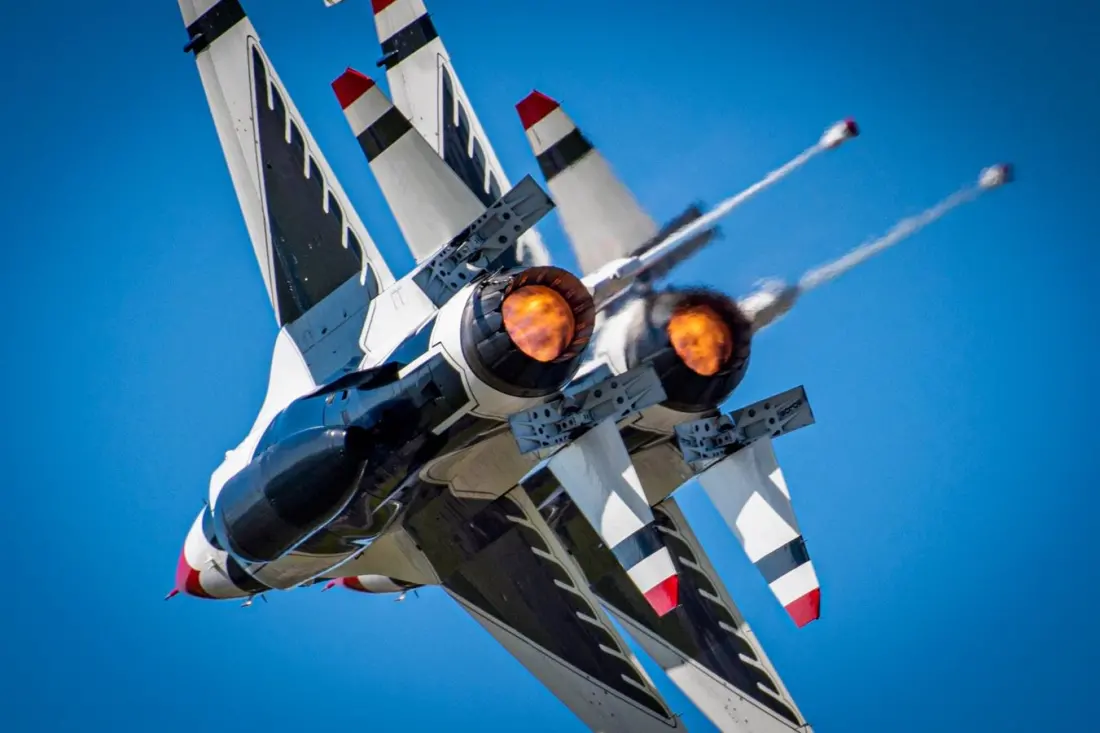
The US Air Force Thunderbirds fly their F-16s within 18 inches (0.45 metres) of each other in the signature four-ship Diamond formation, and there's no automation keeping them apart. It's all done by eye: pilots learn to hold fixed visual references, positioning parts of the neighbouring aircraft at precise points on their canopy or HUD, while suppressing the instinct to glance at the ground. The team, based at Nellis Air Force Base in Nevada and founded in 1953, is one of the two oldest formal aerobatic teams anywhere, alongside the Navy's Blue Angels.
Their show is built around a four-ship Diamond, a six-ship Delta and two solo aircraft, with routines that break and re-form these shapes constantly. Standout moves include the Diamond Loop, where all four jets climb through a vertical loop in tight formation, and the Diamond Roll, where the formation rolls as if it were one aircraft. The Diamond Cloverloop strings multiple direction changes into a clover-shaped path, while crowd favourites like the Crossover Break and the Bomb Burst send aircraft seemingly converging or exploding outward from a single point.
None of it is risk-free. The team suffered the infamous 'Diamond Crash' in 1982, when all four T-38s and their pilots were lost, prompting a major overhaul of training. Further Thunderbird crashes followed in 2003, 2017 and 2018, though none involved a mid-air Diamond collision. Globally, a fast-jet display sortie carries roughly a one in 3,000 to one in 10,000 chance of a crash — about 1,000 times riskier than a commercial passenger flight. The point was underlined in May 2026, when two Navy EA-18G Growlers collided during the Gunfighter Skies airshow at Mountain Home AFB; all four crew ejected before the jets hit the ground and burned.
The current fleet is a curiosity in itself: six single-seat F-16Cs and two twin-seat F-16Ds, Block 52 conversions of airframes built in the early 1990s and rebuilt in 2008 with stripped weapons systems, upgraded avionics and smoke generators. Unusually, they're frontline fighters rather than trainers — unlike the Red Arrows' Hawks. The 2026 team is led by Lieutenant Colonel Alexander Prevandar, with the roster split between two lieutenant colonels and four majors.
For travellers, this matters because the Thunderbirds perform more than 60 shows a year at over 30 locations, and airshows remain one of the best-value days out in the US — often free to watch from public viewing areas. If you're near a show on their circuit, the Diamond manoeuvres and the break sequences are the moments to watch for, best appreciated from near show centre where the formation work is closest.