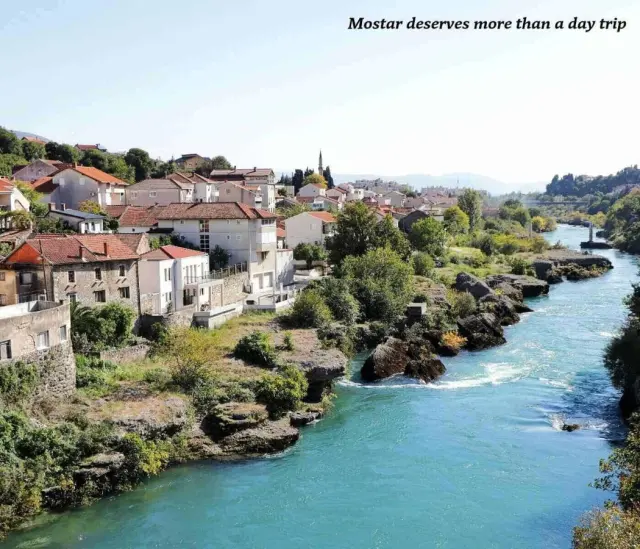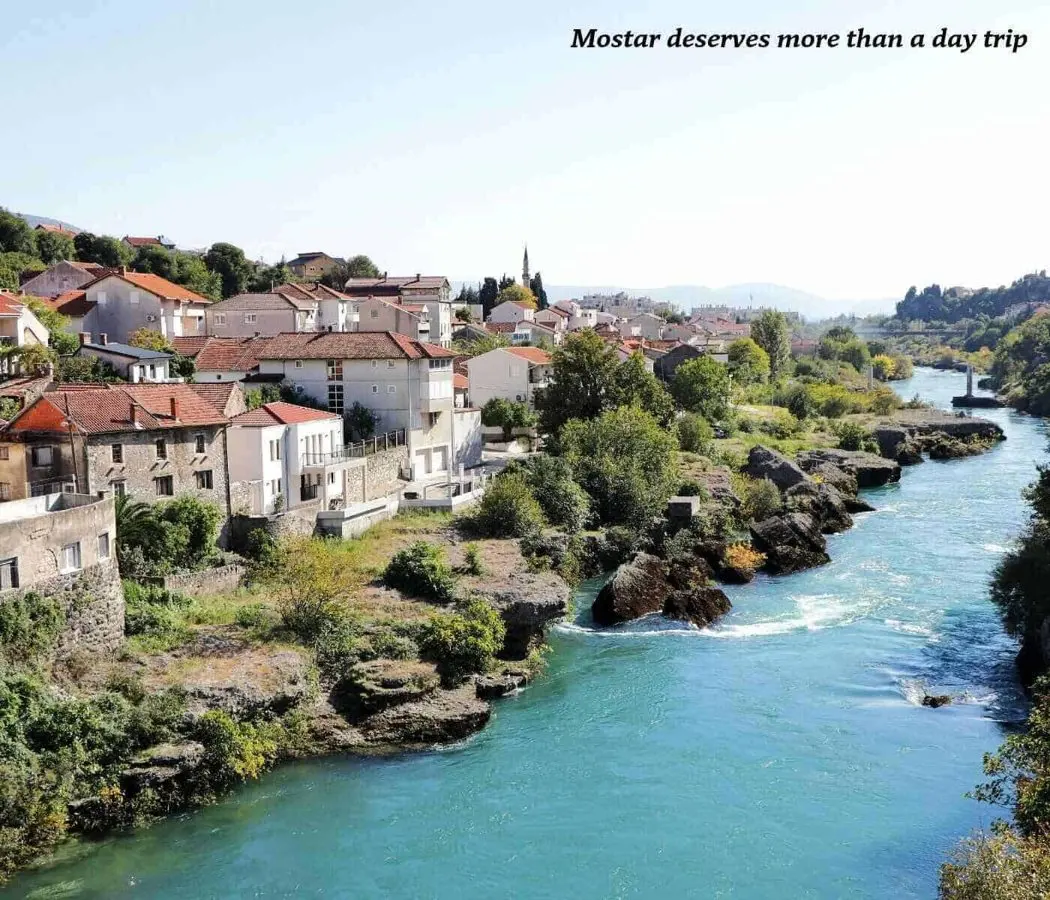
Mostar gets slotted into Croatian coast itineraries as a quick day trip, but the old town only really reveals itself once the tour buses leave. Stay a night or two and you get the calm evening version of the city, plus easy access to wine country, waterfalls and mountain plateau that most visitors never reach.
Start with the obvious icon: the Stari most, a single-arch stone bridge rebuilt as an exact replica of the 16th-century original designed by Hajrudin, a student of Ottoman architect Sinan. From a 24m drop, members of the Bridge Divers' Club plunge into the Neretva river below most days in spring and summer — though they expect a crowd-funded tip of around 60–100KM before they leap. Two diving competitions run each summer, and if you're feeling reckless, you can sign up to jump yourself for roughly 100KM, training included.
The streets around the bridge reward slow wandering. Kujundžiluk, the old trading lane, is lined with coppersmiths, carpet-makers and painters whose workshops are genuine working businesses, not props — and it offers the classic photo angle on the bridge. The 1617 Koski Mehmed-Pasha Mosque lets visitors climb the minaret for a small fee, while the Tepa market, trading since Ottoman times, is the place for seasonal figs, pomegranates and Herzegovinian honey.
Mostar's 20th-century history isn't glossed over. A photo exhibition inside the western bridge tower shows Wade Goddard's black-and-white images from the 1992–95 war, and the Museum of War and Genocide Victims 1992–1995 is among the most sobering in the country. Across the bridge, the Stari most Museum in the Tara Tower takes you under the structure itself and screens a UNESCO film by Bosnian director Jasmila Žbanić on the bridge's reconstruction.
For something quieter, visit the surviving Ottoman houses. The 17th-century Bišćevića House, propped on 5m pillars above the river, is still family-owned and guided by the family themselves. The Muslibegović House — often called the finest Ottoman domestic architecture in Bosnia and Herzegovina — runs 20-minute tours but also operates as a boutique B&B, letting you sleep like a 17th-century nobleman.
Need adrenaline? Fortica Adventure Park on the hill above town has the country's longest zipline at 570m, a 15m glass Skywalk, and a former Italian bunker serving as a mountain lodge. Alternatively, climb the 107m Peace Bell Tower by the Franciscan church for what's arguably the best panorama in town (10–15KM).
Day trips fill the rest of a 48-hour stay. Počitelj, a half-hour south, is a rebuilt Ottoman village with a long-running artists' colony and tentative UNESCO status. Blagaj, under 20 minutes away, centres on the photogenic Buna river spring and riverside trout restaurants. The Podveležje plateau, at 700m, offers shepherd traditions, wind farms and near-empty roads for walking and cycling.
The practical takeaway: Mostar works as a base, not a stopover. Two days let you cover the historic core, one adventure outing and a day trip — without fighting day-tripper crowds at every turn.
Thanks to Bradt Guides for the original guide.