
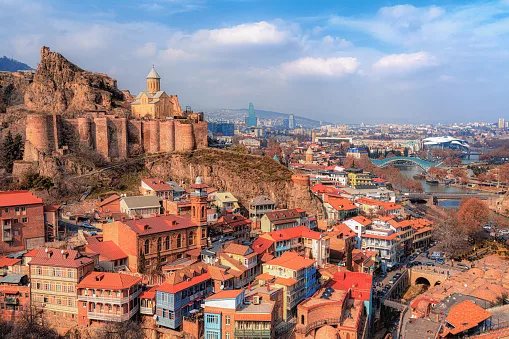
Skip the postcard version of Tbilisi for a moment. Georgia's capital rewards travellers who push past the Old Town's cobbled lanes into its markets, Soviet-era leftovers and rapidly growing creative districts — and it can all be packed into a weekend.
Start day one early at Dezerter Bazaar, the sprawling agricultural market near the Central Railway Station. Around 2,000 square metres of stalls sell fruit, herbs, cheeses, spices, nuts and Georgian specialities like churchkhela (walnut candy strings), tkemali plum sauce and tklapi fruit leather. Arrive from about 07:00, when things kick off, and browse slowly — watching locals shop is half the point.
From there, walk to Chugureti, a neighbourhood north of the Mtkvari River where tired older residential blocks now share streets with cafés, studios and independent businesses. The highlight is Fabrika, a former Soviet sewing factory turned into a multi-storey hub of cafés, restaurants, shops and social spaces. It's the clearest example of how Tbilisi is repurposing its industrial past, and the courtyard is a good spot for a coffee.
In the afternoon, head to the Dry Bridge Market, a flea market running in roughly its current form since the 1950s. Expect Soviet memorabilia, old cameras, porcelain, jewellery and second-hand oddities, plus an open-air gallery of paintings nearby. It generally operates from about 09:00 to 17:00, and it rewards browsing over hunting for anything specific.
Dinner should be a full Georgian spread: khinkali dumplings, khachapuri cheese bread, pkhali (vegetable-and-walnut pastes) and grilled mtsvadi. Note that khachapuri varies by region — the boat-shaped Adjarian version comes topped with egg and butter, while the round Imeretian one is simply packed with cheese. Portions are made for sharing.
Day two begins on Rustaveli Avenue, the city's 1.5-kilometre main artery, lined with the Georgian National Gallery, the Opera and Ballet Theatre, Rustaveli Theatre and the Modern Art Museum. The gallery is the pick of the bunch, with works by Niko Pirosmani, Davit Kakabadze and Lado Gudiashvili. For lunch, try lobio (bean stew), ajapsandali or the city's own kalakuri khinkali, stuffed with herbs.
Then do the one thing every first-time visitor should: a soak in the sulphur baths at Abanotubani, the domed bath district where naturally heated mineral water has risen beneath the city for centuries. Book a private room if you want one, and go for the kisa — a bracing exfoliating scrub with a coarse cloth. Finish with wine and a long dinner; Tbilisi's wine bars are half its charm.
Practically, you don't need a car. The metro runs 06:00 to midnight, buses and minibuses to roughly 23:00, and most stops here link up on foot once you're in the area. Leave slack in the schedule — the courtyards and side streets between attractions are where Tbilisi reveals itself as a city that's historic but very much still moving.