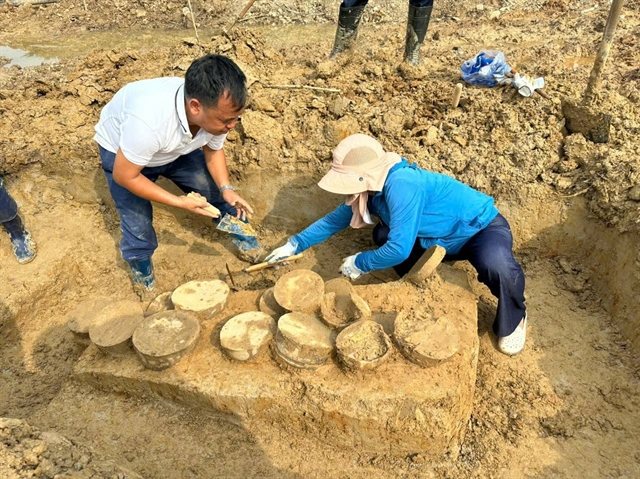
A Vietnamese family digging foundations for a new house got more than they bargained for: six ceramic jars, buried roughly 30cm underground and apparently left there some 700 years ago.
The discovery happened on October 11 in Hoa Lư Ward, in northern Vietnam's Ninh Bình Province. Rather than quietly keeping or selling the pots, the family called the authorities — a move now earning them formal commendation from provincial officials.
Specialists from the Ninh Bình Provincial Museum arrived, documented the site and took custody of the haul: six jars plus a scatter of ceramic fragments. What makes the find interesting isn't just the age but the arrangement. The jars were laid out in two east–west rows across a patch just 2.2 metres long and half a metre wide, stacked three layers deep — some placed upside down on top of each other, others sealed mouth-to-mouth. Whoever put them there clearly had a system.
The museum's preliminary dating places the ceramics in the Trần Dynasty period, the 13th–14th centuries. They're high-fired, fine-grained stoneware in two styles — straight-sided and curved-shoulder — some decorated with incised lines and comb patterns. The jars held only soil; an expanded sweep of the surrounding area turned up nothing else, and officials decided there wasn't enough evidence to justify an emergency excavation. Construction can go ahead, with the museum monitoring the site under the Law on Cultural Heritage in case anything else surfaces.
For travellers, the backstory is arguably as interesting as the pots. Locals recall the spot as former Đồng Hà farmland with sandy mounds planted with maize, peanuts and beans, until the land was cleared in 2010 for a resettlement area and levelled with a metre of excavation. Family graves from the Trần and Nguyễn clans once dotted the area — a reminder that in Vietnam's Red River Delta, ordinary ground often sits on layers of history.
The site also sits close to living Trần Dynasty heritage. A Nậu Pagoda nearby honours King Trần Thái Tông and Princess Trần Thị Ngọc Một, and Đức Thánh Cả Temple (also called Đô Thiên Temple) is dedicated to a Trần Dynasty general. Ninh Bình itself is one of northern Vietnam's most rewarding provinces: the ancient capital of Hoa Lư, the limestone karst scenery of Tràng An and Tam Cốc, and far fewer crowds than Ha Long Bay. This find is a small, human-scale window into the same era — and a nice story about a family that did the right thing when their garden gave up a secret.
Why it matters: if you're travelling through Ninh Bình, this is a good prompt to stop at the provincial museum and the Hoa Lư historic sites, where artefacts like these end up — and to remember the region's history runs well beyond the postcard viewpoints.
Report by Vietnam News Life.