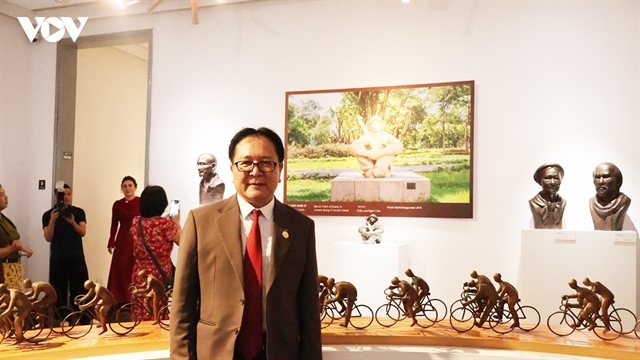
A veteran Vietnamese sculptor is showing a softer, funnier side of himself in the capital. Vương Duy Biên, best known for heavyweight public monuments, has unveiled Chuyện To Chuyện Nhỏ (Big Stories, Small Stories) at the Việt Nam Museum of Fine Arts in Hanoi — 50 sculptures spanning the past ten years, and his first solo show since 2015.
Biên's argument is that size doesn't dictate the weight of a story. His monumental bronzes, woods and stones in public squares carry the memory of whole communities, he says, while a small figure or an everyday scene can say just as much about human nature. That idea shapes the show: playful works like Big Chair, Small Chair; As Long As You Can Sit; Let's Come Second and Please Queue in Order use ordinary objects and wry titles to poke at social status, hierarchy and how people treat each other. Other pieces turn children, village life and rural objects into sculpted personal memory.
The exhibition also nods to Biên's impressive résumé. As a student at the Việt Nam University of Fine Arts he already had a work acquired by the museum hosting this show. At 29 he won the competition to design a monument to the 13th-century military leader Trần Hưng Đạo, unveiled in 2000. Replicas of several of his big public works are on display here too: the Trần Hưng Đạo monument, the Hồ Chí Minh monument in Dương Đông Square on Phú Quốc island, Soldier's Smile at the Quảng Trị Ancient Citadel, and the monument to late Party General Secretary Trường Chinh in Ninh Bình province. Biên now heads the Việt Nam Cultural Industry Development Association.
Museum director Nguyễn Anh Minh summed up the opening: each piece, he said, tells a story and reflects on art, human nature and life itself. The exhibition runs until October 18 at the museum's address on Nguyễn Thái Học Street.
For travellers, this is an easy add-on to any Hanoi itinerary. The Fine Arts Museum sits in the French Quarter district, a short walk from the Temple of Literature, and offers a compact, air-conditioned hour or two of Vietnamese art history — from classical and folk work to contemporary sculptors like Biên. His show is a rare chance to see both ends of a single career in one room: the civic monuments every local knows, and the small, intimate pieces few ever get to see. Even if you can't read a word of the titles, the humour translates.