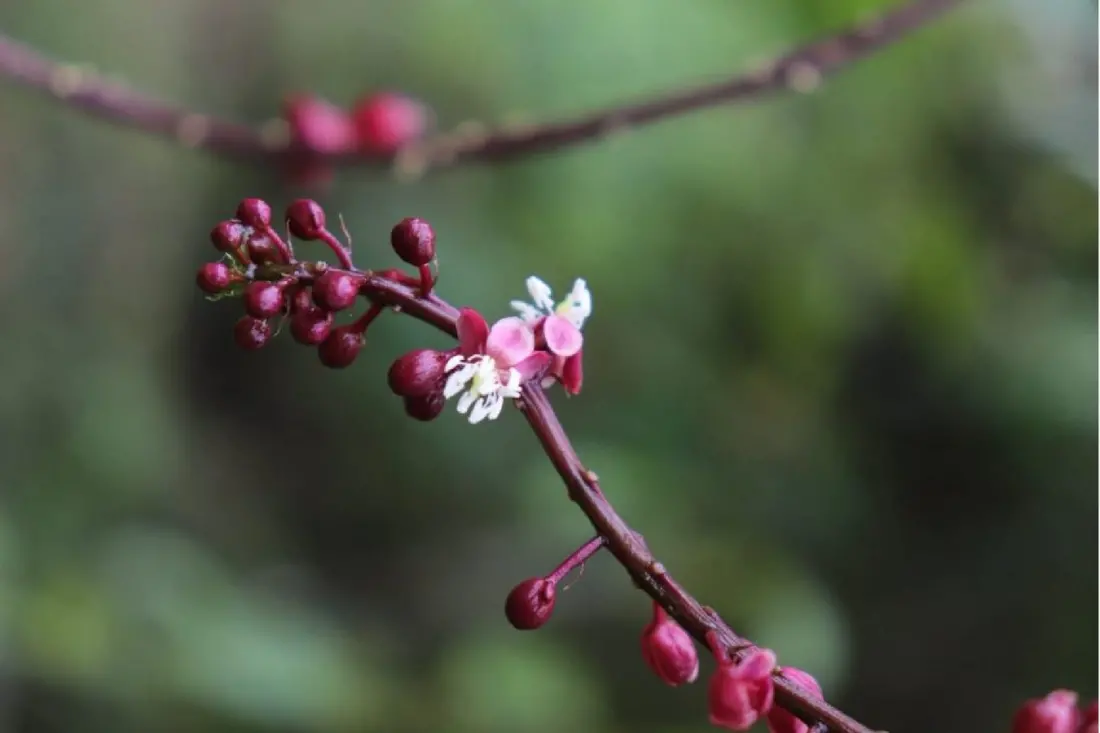
Scientists have confirmed a plant species new to science, and it turned up somewhere fitting: Cueva de los Guacharos National Natural Park, the reserve that became Colombia's very first protected area back in 1960. The find is a shrub called Trichostigma guacharense, described in the journal Brittonia by a team from Universidad Militar Nueva Granada and Universidad de los Andes, working alongside the park's rangers.
The shrub grows to around three metres tall in humid montane forest, at elevations of 1,800 to 2,150 metres in the southern Andes, straddling the departments of Huila and Caqueta. So far it has only been recorded inside the park, which makes the reserve its entire known home on Earth. What sets it apart from its relatives are grooved leaf stalks, a distinctive stamen arrangement, oddly shaped fruits, and inflorescences that flash reddish-magenta — flashy traits for a genus that botanists admit is still poorly studied across Colombia despite ranging from sea level to 2,200 metres.
The name itself is a nod to history. It honours both the park and the oilbird, the cave-dwelling bird whose nesting colony is the reason the area was protected in the first place. That bird has serious scientific pedigree too: Alexander von Humboldt and Aime Bonpland examined it in September 1799 and introduced it to Western science.
Cueva de los Guacharos covers 7,134 hectares across five municipalities — Acevedo and Palestina in Huila, San Jose del Fragua and Belen de Los Andakies in Caqueta, and Piamonte in Cauca. It protects some of the country's best-preserved Andean and sub-Andean forest, and it welcomes visitors with hiking trails, camping, birdwatching and caving. In other words, the same paths you'd walk as a tourist are active research ground where new species still surface.
For travellers, this is a good reminder that Colombia's national parks are not just scenery. A park protecting one cave bird in 1960 is still yielding botanical firsts more than six decades later — a rare chance to visit a place where the wildlife checklist is literally still being written. Birders and hikers heading to southern Huila usually combine the area with San Agustin's archaeological park nearby, and the region's cloud forests reward anyone patient with binoculars.